Low-emission zones
Environmental labels
The DGT (Spain’s traffic authority) sorts vehicles into four environmental labels (0, ECO, C and B) according to how much they pollute; the rest get no label. The label decides whether you can enter each low-emission zone.
The DGT environmental labels
The five DGT categories and how many low-emission zones (LEZ) in force each one can enter.
-
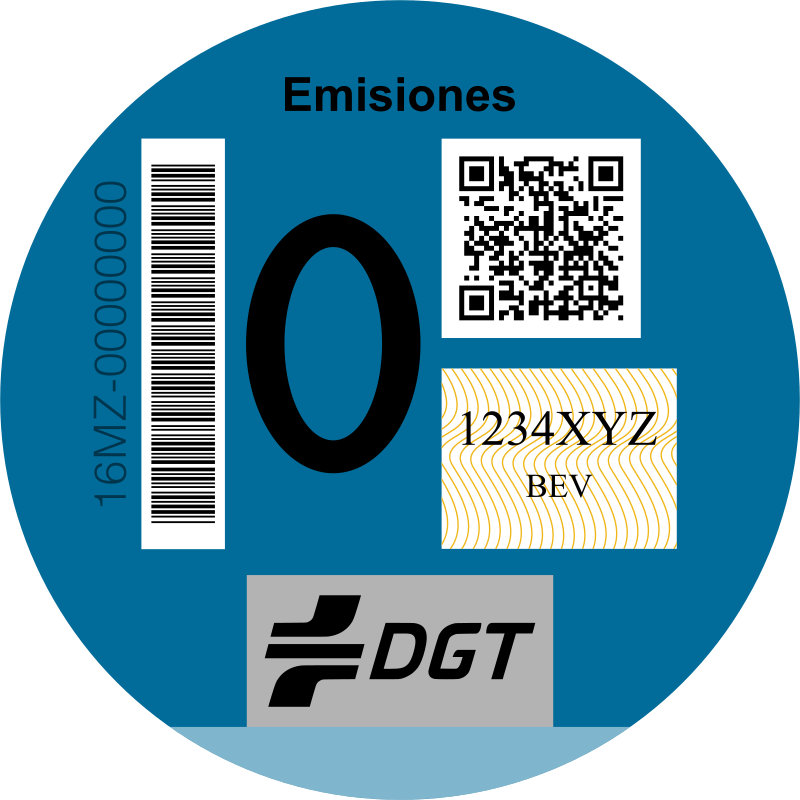
Zero emissions
Vehicles with zero direct emissions while driving.
- Battery electric (BEV)
- Range-extended electric (REEV)
- Plug-in hybrid (PHEV) with ≥40 km of electric range
- Hydrogen fuel cell (FCEV)
53 of 53 zones in force: all of them -

ECO
Low-emission vehicles with some degree of electrification or alternative fuels.
- Plug-in hybrid (PHEV) with less than 40 km of electric range
- Non-plug-in hybrid (HEV)
- Natural gas (CNG/LNG)
- Liquefied petroleum gas (LPG)
53 of 53 zones in force: all of them -

C
Modern combustion engines.
- Petrol registered from January 2006 (Euro 4, 5 and 6)
- Diesel registered from September 2015 (Euro 6)
51 of 53 zones in force it can enter -

B
Combustion vehicles meeting emission standards older than the most recent categories.
- Petrol registered from January 2001 (Euro 3)
- Diesel registered from 2006 (Euro 4 and 5)
48 of 53 zones in force it can enter -
No sticker
No label
Vehicles that do not meet the requirements for a DGT environmental label.
- Petrol registered before 2001
- Diesel registered before 2006
13 of 53 zones in force it can enter
Can my car get in?
Choose your label and see how many LEZs in force you can drive in.
Your label
How to find out which one you have, how to get it and whether you need to display it.
Which label do I have?
You can check it in seconds on the DGT online portal by entering the number plate: you do not need to be the owner or sign up, and it works for any vehicle. The classification belongs to the car, not to the sticker.
Look up a vehicle's environmental label (in Spanish)
How to get the sticker (and what to do if you lose it)
It is issued by the DGT and costs about €5. You can get it at:
- Correos post offices (they usually hand it over on the spot).
- Participating garages (CETRAA members and chains such as Euromaster or First Stop).
- Tobacconists and some authorised online shops.
You need the vehicle registration certificate and the owner’s ID.
If you lose it or it gets damaged, there is no special duplicate: you apply for a new one through the same channel and at the same price. The label is linked to the vehicle in the DGT register, so replacing the physical sticker does not change the car’s environmental classification.
Do I need to display it?
It depends on the check. Nationally, displaying the label is voluntary, and if you do display it, the DGT says it must be stuck to the bottom right-hand corner of the windscreen.
LEZ cameras do not need it: they read your number plate and match it against the label registered with the DGT, so your car is classified the same whether you display it or not. It is worth displaying it in two cases:
- Roadside checks or high-pollution days: if an officer cannot see it, they cannot give you the benefits at a glance even if your car qualifies.
- Municipalities that require it by ordinance: Madrid requires it to be visible on the windscreen (art. 6.1 of its Sustainable Mobility Ordinance), and it is also required to enter the Barcelona LEZ. Not displaying it there can lead to a fine.
How the system works
What the label classifies, which labels are restricted first and why electric cars are not affected.
What the label classifies
The label classifies by year of registration and technology (the Euro standard), not by what the car actually emits on the road. That is why a large Euro 6 diesel gets the C and a small plug-in hybrid gets the ECO, an order that does not always hold on the road. It is an administrative label: it serves as a reference, it does not measure each car’s emissions.
Which labels go first
The B and C labels are the ones banned in phases as each city tightens its LEZ, after vehicles with no label. We explain it in the regulations and their phased timetable.
If your car is electric, always the 0
A battery electric car has the zero emissions label, the only one that is not restricted in any LEZ, either now or in the phases to come.
If you are thinking of changing your car, it takes low-emission zones out of the equation: have a look at the electric models.
More on low-emission zones
Coverage calculated across the 53 zones in force in the 42 municipalities we track. Label classification according to the DGT. Each LEZ may apply its own exemptions and timetable; check the page for your municipality.