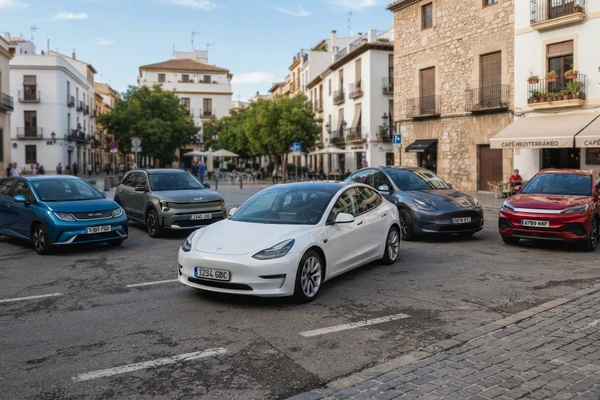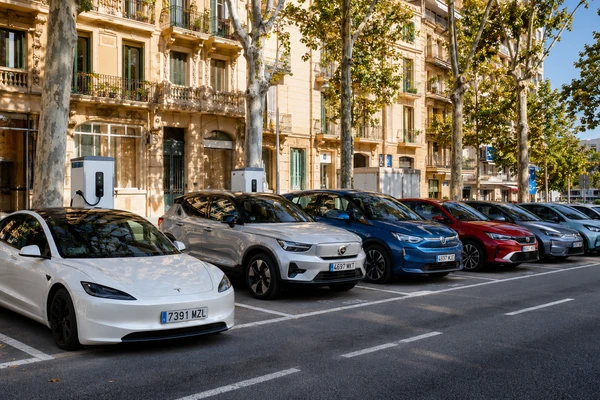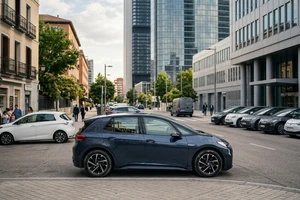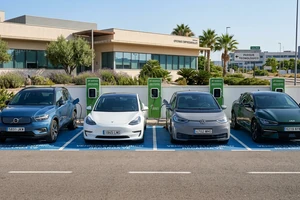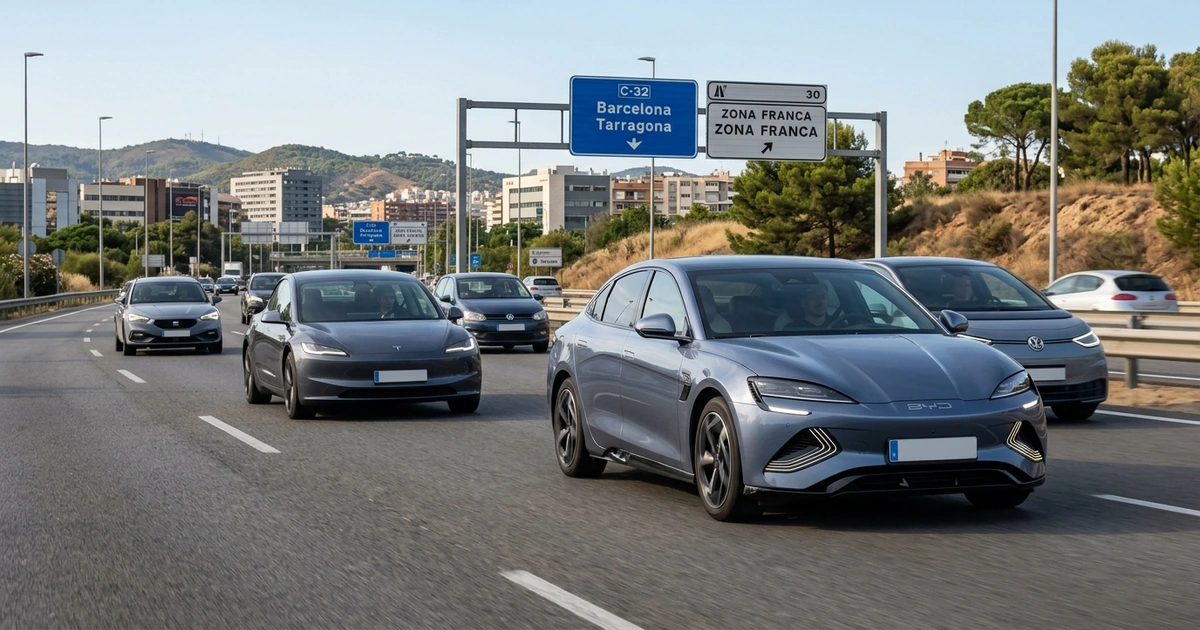
In August 2026, 1,610 new fully electric passenger cars were registered to owners based in Catalonia, the region around Barcelona in north-eastern Spain. That represents 17% of all electric cars registered in Spain, roughly one in six. The Catalan market grew 39.9% year on year, from 1,151 units in August 2025 to 1,610 this year, well ahead of the 31.7% growth recorded across Spain. But growth is not the most interesting part of the month. What stands out is who leads the ranking: the BYD Seal and the Tesla Model 3 sit at the top, but they get there through very different channels. One is overwhelmingly driven by registrations to legal entities; the other by private buyers.
We count each registration in the Spanish region where the vehicle's owner is based, not where the vehicle is registered administratively. This is the Catalonia detail; we cover the Spain-wide ranking for August separately.
In this article 7 sections
- The 20 best-selling electric cars in Catalonia in August 2026
- Two sedans lead, two different channels
- Cupra loses momentum: from first to sixth in a month
- Year to date: Tesla still leads in Catalonia
- Electric cars are gaining weight in Catalonia's overall market
- Who is buying electric cars in Catalonia
- Methodology and data source
01The 20 best-selling electric cars in Catalonia in August 2026
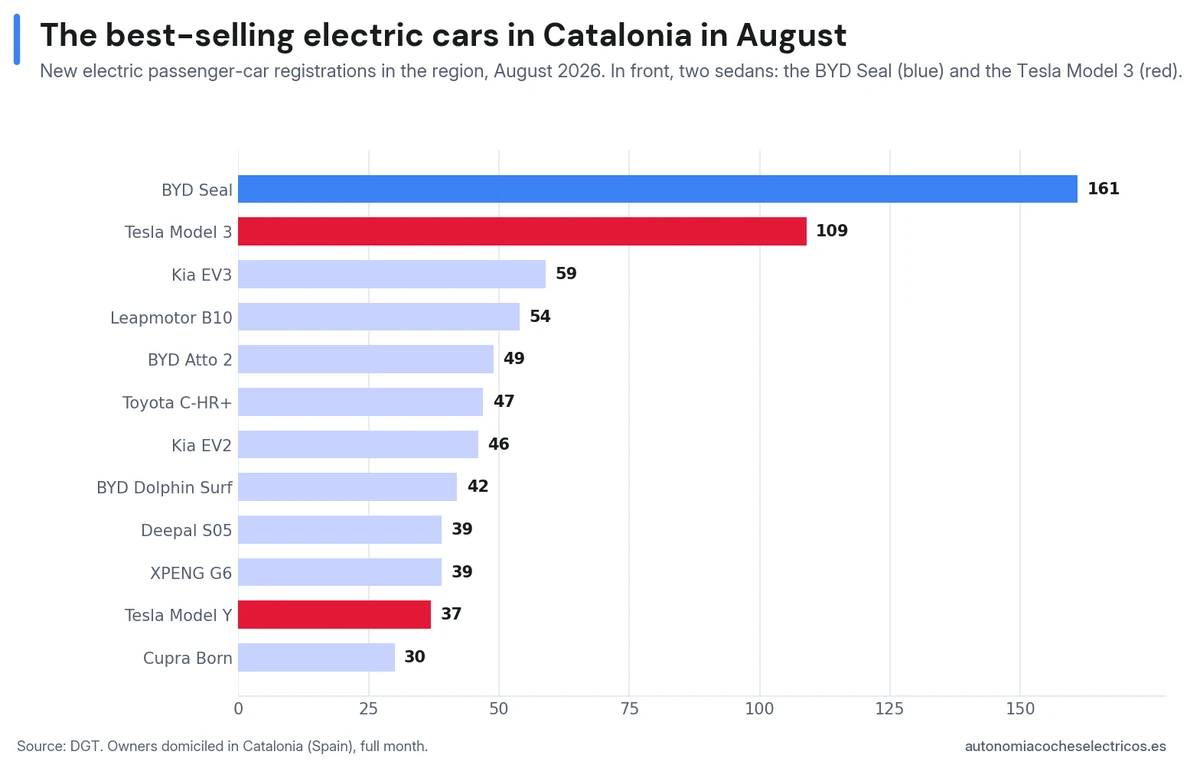
The BYD Seal leads with 161 units, well ahead of the Tesla Model 3 (109). Behind them come the best-sellers of the Spanish market: the Kia EV3 (59), the Leapmotor B10 (54) and the BYD Atto 2 (49). Cupra, which had been the month's protagonist in Catalonia in July, now appears spread out and lower down: the Born is fifteenth, the Tavascan nineteenth and the Raval twentieth.
02Two sedans lead, two different channels
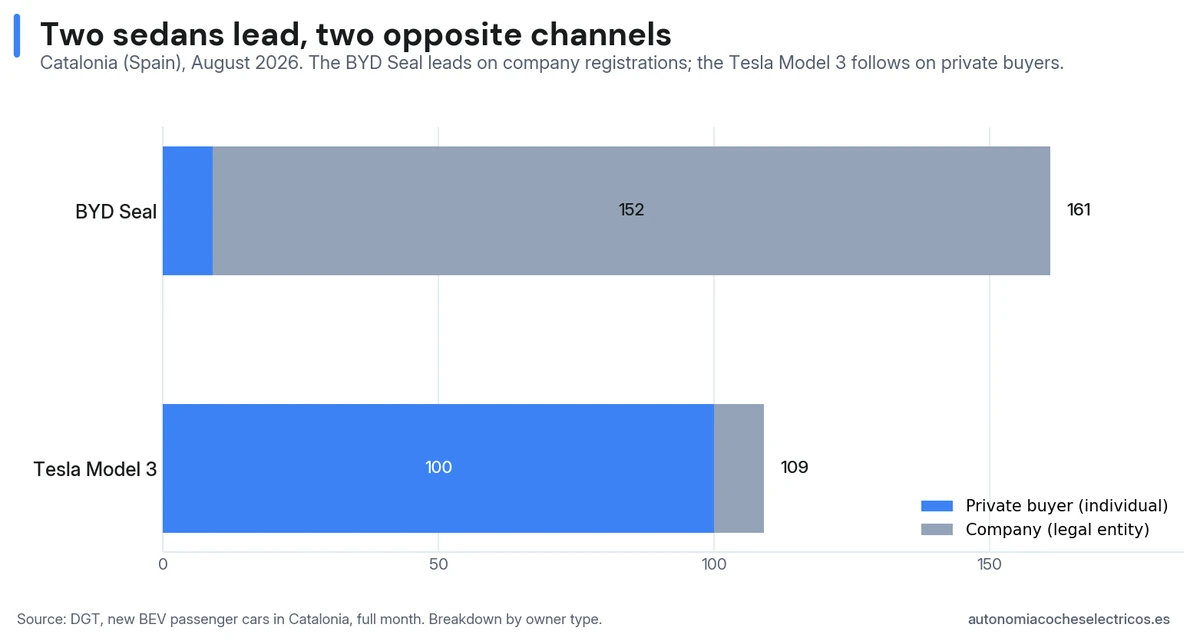
First and second place tell opposite stories. Of the BYD Seal's 161 registrations, 152 —94%— are registered to legal entities. The registrations are also heavily concentrated in Barcelona province, with 159 of those 161 owners based there. The Tesla Model 3 is the reverse: 100 of its 109 registrations are in the name of private individuals.
That split changes the ranking depending on who you count. Look only at registrations to private individuals and the Seal drops out of the leading group —barely 9 of its units are private— and the model most registered by private individuals in Catalonia is the Tesla Model 3, followed by the Kia EV3 (57) and the Leapmotor B10 (52). The month's overall leader, then, is not the model most bought by private individuals: it is the model most heavily driven by company registrations.
03Cupra loses momentum: from first to sixth in a month
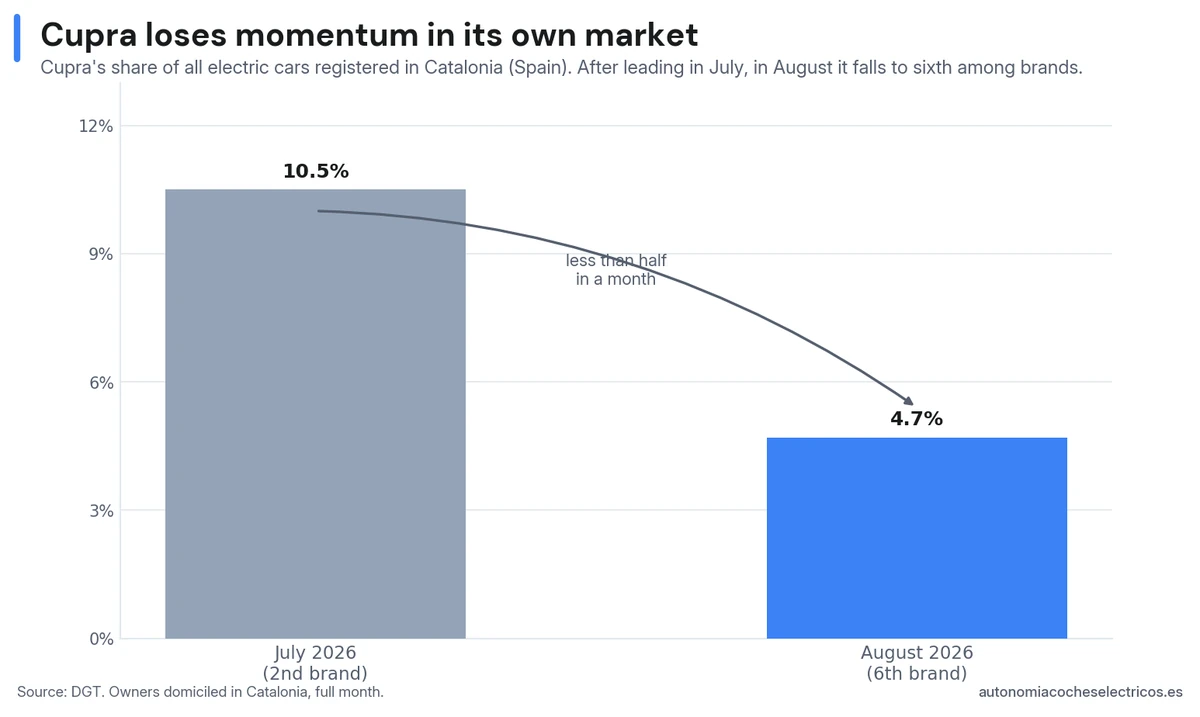
In July, Cupra —a Spanish brand of the Volkswagen Group— had fought BYD for the brand lead and accounted for a share of the Catalan market more than three times its share across Spain. In August, that momentum cooled: the brand fell to sixth with 75 units and a 4.7% share, less than half the 10.5% it recorded the previous month. Its registrations remain heavily concentrated in Barcelona province: 86.7% of its owners are based there. It remains a distinctive pattern in the Catalan market, but with far less volume than at the height of summer.
BYD leads the region with 19.0%, well above its share across Spain, driven above all by the Seal's 161 registrations. Tesla takes second place almost entirely on the strength of the Model 3, which accounts for 109 of its 146 registrations. Across Spain as a whole, however, Tesla's sharp drop in deliveries left it eleventh. Catalonia thus produces a brand ranking that diverges from the Spanish one at the top: the first two places go to the month's two leading sedans, and July's Cupra phenomenon shrinks to sixth.
04Year to date: Tesla still leads in Catalonia
August is a single month's snapshot; the year-to-date shows the underlying picture better. Between January and August, owners in Catalonia registered 13,959 new electric passenger cars, 16.4% of all electric cars registered in Spain so far this year, the second-largest share among Spain's regions, behind Madrid.
Tesla still leads the cumulative figure, followed by BYD. Cupra follows a different path: fourth over the year, an occasional protagonist in summer and sixth in August. Its weight in Catalonia is real, but uneven month to month.
05Electric cars are gaining weight in Catalonia's overall market
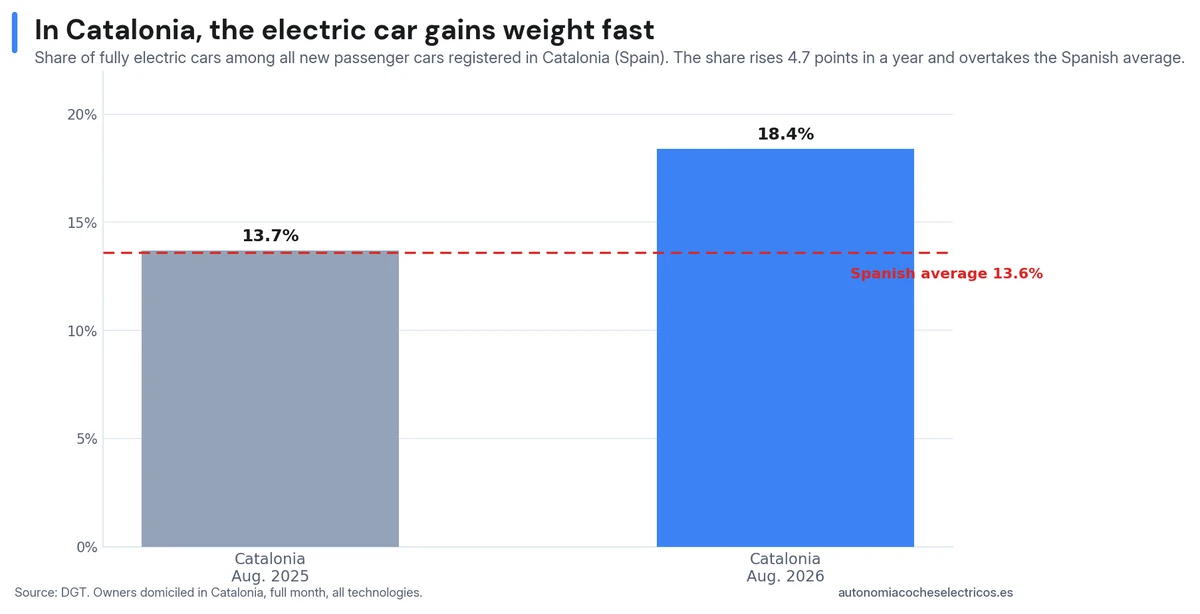
The electric ranking is one part of the market. Catalonia registered 8,754 new passenger cars of all technologies in August. That means 18.4 out of every 100 were fully electric, against 13.7 in August 2025 (1,151 out of 8,402). The share of fully electric cars has risen 4.7 percentage points in a year while the total market has barely moved.
That 18.4% is well above the Spanish average, which reached 13.6% in August. Catalonia is Spain's second-largest market by volume and, on top of that, the share of fully electric cars is higher here than across the country as a whole. In Madrid —Spain's largest regional market— the opposite happens: it leads in units but remains below the national average in share. These are two different ways of being a major EV market.
06Who is buying electric cars in Catalonia
Of the 1,610 registrations, 1,117 (69.4%) are made by private individuals and the other 493 (30.6%) by legal entities. The private channel weighs far more in Catalonia than in the Madrid region, where private individuals stay at 48.1%. That contrast helps read the month: although the best-selling model in absolute terms is the company-driven BYD Seal, private buyers account for most of the Catalan market, and among them the ranking is led by the Tesla Model 3.
The group of Chinese-capital brands reaches 37.5% of the Catalan electric market, somewhat above the 33.8% for Spain as a whole, driven above all by BYD's volume. That split —a Chinese brand at the top on company registrations, an American one just behind on private demand— is what shapes the month.
Read the August ranking by who signs the paperwork, and it splits in two. Which car "won" depends on which market you mean, and in Catalonia the private market —by far the larger one— puts the Model 3 at the top, not the Seal that tops the overall table. Compared with Madrid, the contrast holds: Madrid wins on volume, Catalonia on proportion and on private demand.
07Methodology and data source
The data in this article comes from the official registration database of the Directorate-General for Traffic (DGT), part of Spain's Ministry of the Interior.
The following filters were applied to the raw data:
- Vehicle type: Passenger car. Vans, light commercials, trucks, buses, motorcycles and mixed-use vehicles are excluded.
- Powertrain: Battery electric (BEV). Plug-in hybrids (PHEV), hybrids (HEV) and extended-range electrics (REEV) are excluded.
- New/Used: New vehicle. Second-hand registrations are excluded.
- Territorial scope: Catalonia (Barcelona, Girona, Tarragona and Lleida), taken as the owner's domicile, not the region where the vehicle is registered administratively. This way the figure reflects where the owner is based and not where a leasing company or fleet processes the registration.
- Chinese block: groups the brands controlled by Chinese business groups (BYD, Leapmotor, Deepal, XPENG, MG, Omoda, Jaecoo, Lynk & Co, Smart, Geely and Denza, among others), regardless of where the vehicle is built. It is therefore not equivalent to "cars made in China." It does not include KGM (Korean) or DS (French).
- Purchase channel: the main ranking includes all registrations (private buyers, companies and leasing fleets). The private-buyer breakdown is calculated from the same DGT database, filtering registrations in the name of a private individual.
The figures reflect registrations of new fully electric passenger cars with owners based in Catalonia during August 2026, with data closed as of 31 August 2026, and include purchases by private buyers, companies and leasing fleets. Comparisons with earlier months and years are recalculated using the same method on the full dataset. Market-share figures against the total passenger-car market come from the same source, covering all powertrain technologies.