The Ministry of Industry has published the White List of the Auto+ Plan, the document that determines, car by car, how much aid each model receives. This is not a minor formality: it is the official table that establishes which vehicles meet the two criteria of European origin of the program, and it determines the final portion of the subsidy, up to 450 euros for a private passenger car.
The interesting part is not how many cars are included, but how many are only partially included. We have analyzed the 281 fully electric models (BEV) included in the White List of the Auto+ Plan, and the result reveals a clear pattern: 53 do not reach the maximum aid because they do not meet the European content criterion in the battery. This group includes unexpected names: the Mercedes EQA, the Renault Twingo E-Tech electric, the Hyundai KONA, and the current Tesla Model Y.
At a glance, this is how those 281 electric vehicles are distributed:
The conclusion is striking: the bottleneck is no longer in manufacturing cars in Europe, but in manufacturing their batteries here. Setting up a car assembly plant in the EU is an investment many brands have made for decades; locating the assembly and part of the battery production in Europe is much more recent, and a significant portion of the cell industry remains in Asia. The Auto+ Plan rewards precisely that second step, the one that is lagging behind, and that is why it leaves the most cars out of the top tier.
What the White List is and what it decides
The Auto+ Plan distributes aid with a points system we call EEE (Electric, Economic, European). The first two criteria depend on the car —that it is electric and that its price is below a certain threshold— and are easy to verify. The third, the European criterion, is more challenging: it requires knowing where the car is manufactured and where its battery is produced. The White List is the official answer to that question.
It assigns each model two origin criteria: European assembly, which contributes 15% of the incentive, and European content in the battery, which contributes the remaining 10%. A car that meets both reaches the top; one that only meets the assembly falls 10% short of the ceiling, those 450€ for a private passenger car. With a nuance worth noting: the list is built with the responsible declaration of each manufacturer, not with a Ministry audit.
Where the aid slips away: always the battery
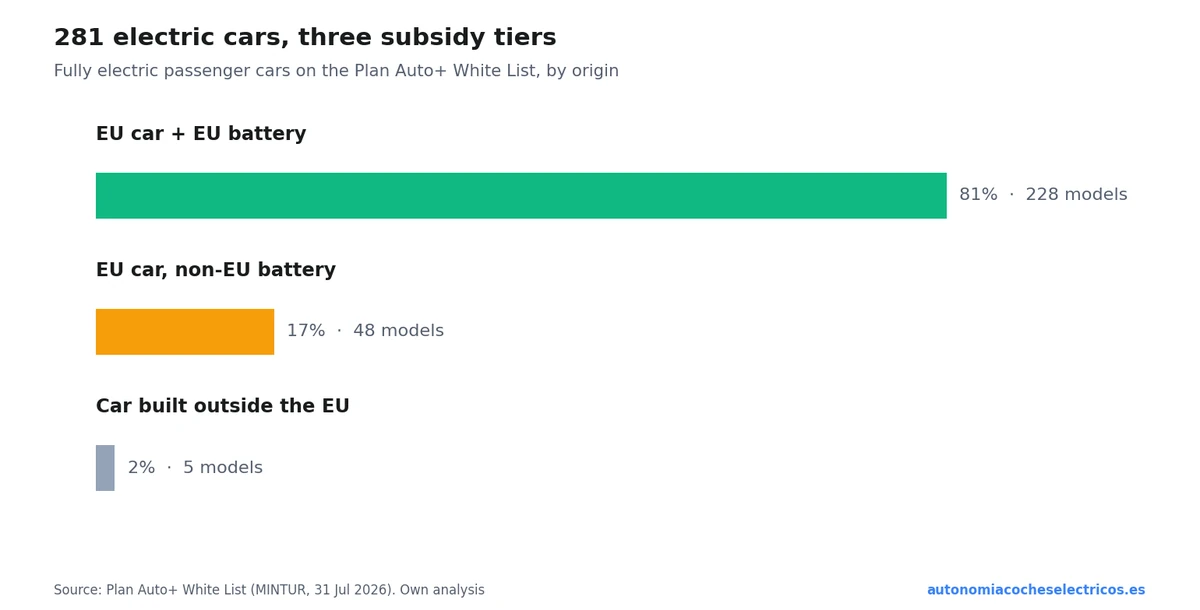
Of those 53 models that do not meet the battery criterion, the vast majority —48— are assembled in the European Union: they lose 10% solely due to the battery's origin. The other five are not even assembled in the EU, and they are small brands or have very limited production.
Almost no one fails due to assembly. Major manufacturers assemble in Europe without exception. The origin of the battery has become the factor that most limits access to the maximum aid, and this is where brands we consider completely European stumble.
The surprising names
That a Chinese electric car falls short surprises no one. What is striking is the company it keeps in that category: established European brands.
Mercedes-Benz is the clearest case. Its entire range of electric passenger cars on the list —the EQA, the EQB, and the EQE Sedan— is assembled in Germany but declares a non-European battery, so none reach the top: they fall 10% short. A buyer who associates "Mercedes" with "German car, all European" gets a surprise when doing the math.
The other name that stands out is the Tesla Model Y. The version sold today in Spain —the restyling Tesla calls Juniper— is manufactured at the Berlin plant but is listed with the European content in the battery marked as "no," so it does not add that 10%. It retains the 15% for assembly.
They are not the only ones. There are also cases like the Renault Twingo E-Tech electric, the Hyundai KONA electric, the Kia EV2, or the Xpeng G6, G9, and P7+, all assembled in Europe but without the portion corresponding to European content in the battery.
Assembling the car in Europe and assembling the battery are not the same
The Auto+ Plan separates the origin of the car from the origin of the battery and pays for each separately. This detail organizes the entire list.
This results in three tiers. A fully European car —assembly and battery— reaches the top. One assembled in Europe with an external battery, the case of those 48 models, falls 10% short. And one entirely manufactured outside Europe loses both portions, the 15% and the 10%.
For the buyer, the practical consequence is that the label "European car" is not enough to know how much aid they receive. A Mercedes assembled in Germany and a compact car assembled in the Czech Republic can end up in the same aid tier as a Chinese electric car assembled in Hungary if none of the three declare a European battery. What makes the difference is a piece of information not found in the showroom or the brochure: where the battery is assembled.
What it means when buying
That 10% is 450€ for a private passenger car: it separates the maximum of 4,500€ from the 4,050€ a European car with an external battery receives. It does not decide a purchase on its own. But it is worth having it handy before signing, because it does not always match what one would expect from the brand.
Is your car on the White List?
Enter your brand, model, or version and check if it appears among the selectable options in the official Auto+ Plan form.
Search the official list →The White List is also a living document: it records the models and plants as of today and will change as brands move battery production to Europe. A car that today falls 10% short of the top may reach it next year if its manufacturer starts assembling the battery in the EU. When that happens, the box changes and the amount increases.
If you are considering a specific model, you can check in our Auto+ Plan simulator how much it corresponds to according to the White List, with its version and price. And to understand the complete calculation of the EEE system —how motorization, price, and origin combine, and how the IRPF deduction adds up—, you have it in our program guide. A note that does not change with the list: the State aid is paid by transfer weeks after purchase, not deducted from the invoice.
The most sought-after brands of the Auto+ Plan 2026
Each card leads to the eligible models of the brand, with their maximum aid according to the White List.