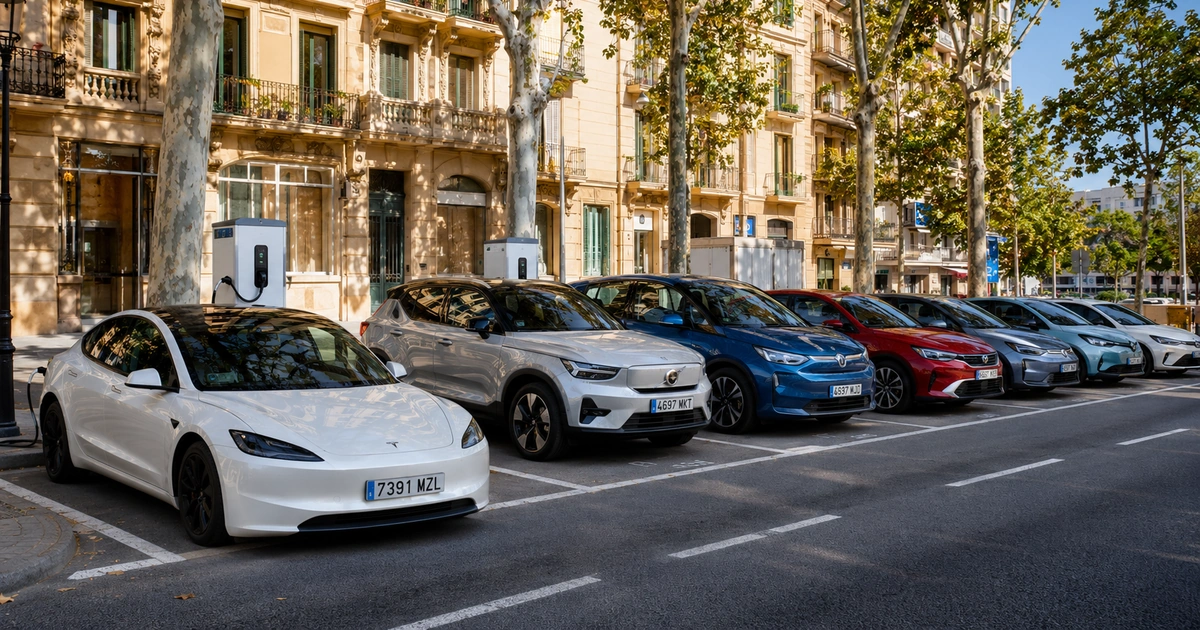

Between January and June 2026, 64,805 new fully electric cars were registered in Spain, a 36% increase compared to the same semester in 2025 (47,463 units). In two years, the market has grown 2.5 times: in the first half of 2024, registrations barely reached 26,039. The transition, which seemed stalled in 2024, has regained momentum.
The full semester reveals what a single month might hide. In the cumulative total, Tesla leads (9,311 registrations, 14.4% of the market), though by a narrow margin: BYD is just 253 cars behind (9,058, 14.0%). The block of Chinese brands now accounts for one in four electric cars sold, after nearly doubling their volume in twelve months. The market relies on a few models: only the Model 3 and Model Y account for one in seven cars for the semester.
Note: The figures in this article are registrations of new fully electric passenger cars (BEV) in Spain between January and June 2026, including purchases by private buyers, companies, and leasing. Plug-in hybrids (PHEV), used vehicles, and vans are not included. These are data from the DGT registration database, closed as of June 30. We have revised the calculation system, so these figures are not directly comparable with those in articles prior to July 2026; all comparisons below have been recalculated using the new method.
The semester in context: 64,805 registrations and a change of scale
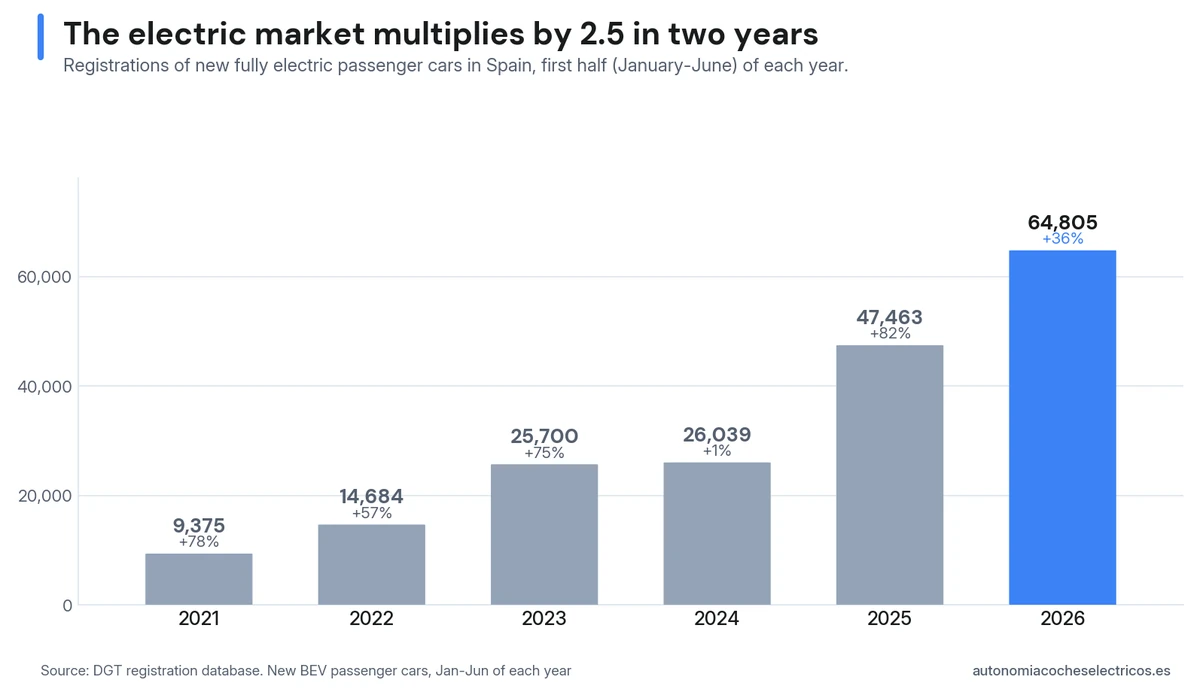
The market has grown by 36% in a year, and this time from an already high base: the 82% rebound in 2025 started from a stagnant 2024 where electric barely moved. Growing by a third when the starting point is already large is more challenging.
The change of scale is evident when looking back ten years. In the first half of 2015, Spain registered a total of 372 electric cars; in 2026, nearly 65,000. In between, there were years of slowdown and rebound, but the direction didn't change: electric cars went from being a niche for pioneers to a stable part of the market.
Compared to other powertrains, electric is also gaining ground. In this semester, almost 1 in 10 new cars registered in Spain was electric; two years ago, it was 1 in 20. The proportion has doubled while the total market barely moved.
And all this with a half-baked incentive: the Auto+ Program, offering up to 4,500 euros per car, was announced but not published in the BOE throughout the semester. It doesn't seem to have slowed sales —even with its predecessor, MOVES III, electric cars grew despite funds running out and delays in aid—, partly because brands, from Volkswagen to BYD, promote the plan as an incentive and even advance the money themselves so the buyer doesn't have to wait for the State.
Who leads the cumulative total: Tesla first, BYD 253 cars behind
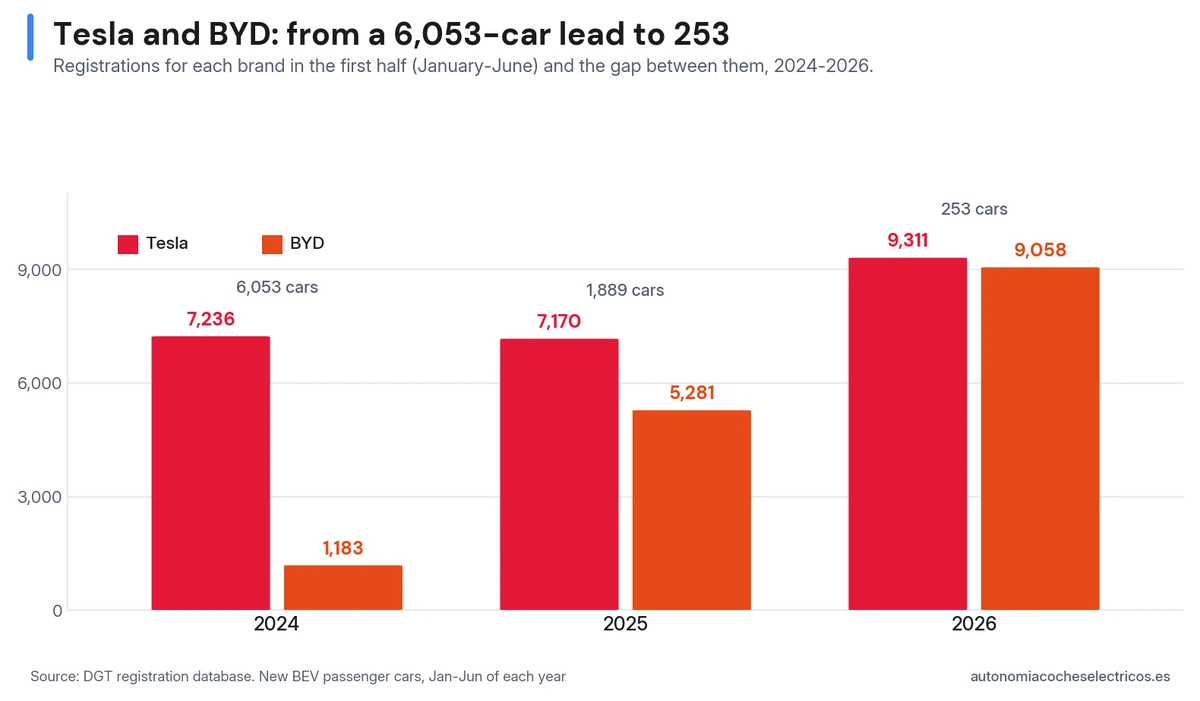
For the entire semester, Tesla is the brand that registered the most electric cars in Spain, with 9,311 units and 14.4% of the market. BYD is second with 9,058 and 14.0%, just 253 cars behind. Together, they account for 28 out of every 100 registrations for the semester; the rest form a long tail where none reach 10%.
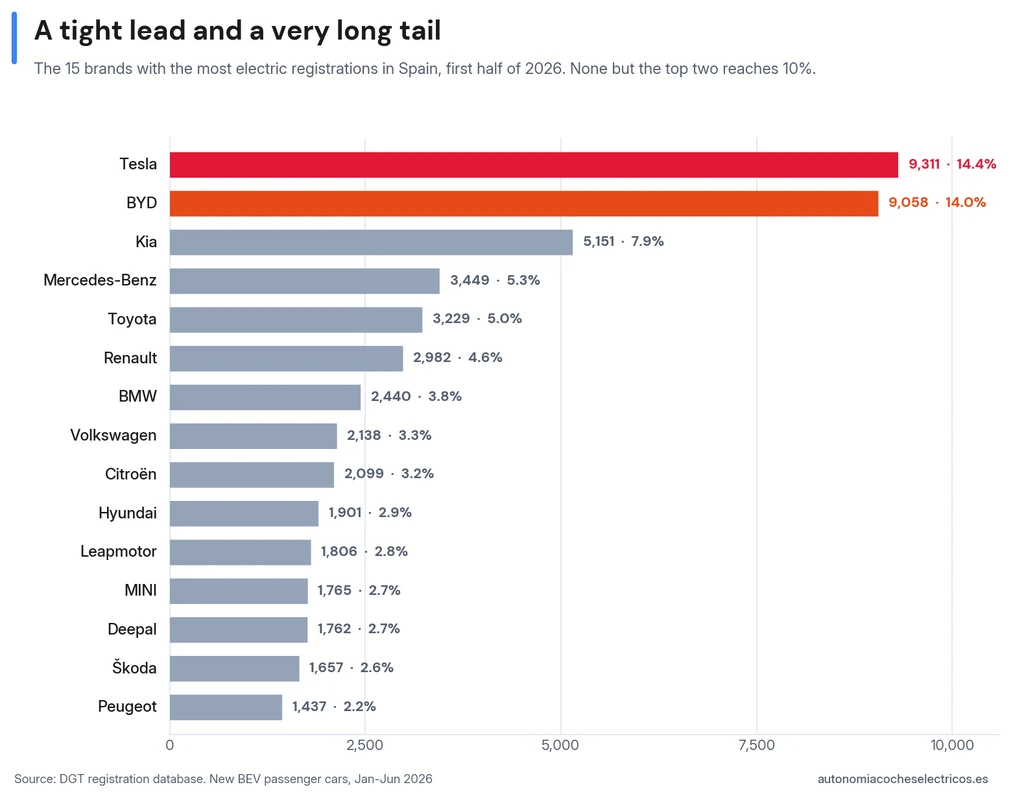
Tesla's leadership for the semester is notable given its sales strategy. The brand doesn't deliver regularly: it concentrates almost all its registrations in the last month of each quarter and leaves the first nearly empty. In January, it registered 458 cars and in April only 301; in March, it was 2,479 and in June 2,786. Looking at the start of a quarter, Tesla seems low in the rankings; by the end, it's soaring. Viewing the entire semester averages these peaks, and yet Tesla remains first. BYD plays the opposite: it spreads its deliveries month by month with the broadest range in the market, not relying on any calendar peak.
The gap with BYD narrows semester by semester
BYD is closing in at a surprising pace. Two years ago, Tesla was six times ahead in the semester; today, they're separated by 253 cars. The table shows it year by year, and in all three, the narrowing trend is consistent.
Tesla is losing share while maintaining sales. It sells more cars today than two years ago, but in 2024 it accounted for one in four electric cars, and today it's less than one in seven. The shift came in 2025 when the market nearly doubled, and Tesla remained at its usual figures. The market grew without it, spreading among many more brands.
This stagnation is due to a deliberate decision: Tesla has reduced its range to two models, the Model 3 and Model Y, to focus production and channel margins into its other businesses, from autonomous driving to robotics. It sells the cars it wants to sell, not all it could. BYD does the opposite: in two years, it has increased its sales more than sevenfold, with a range of eight models from urban compacts to seven-seater SUVs. With the gap now at 253 cars, that breadth is BYD's ace for the second semester.
The Chinese block now accounts for one in four electric cars
The underlying movement of the semester is the advance of Chinese capital brands. They now represent 25% of the market: exactly one in four new electric cars registered in Spain. Just a year ago, they were less than one in six. In twelve months, they have more than doubled their volume, as seen in the table.
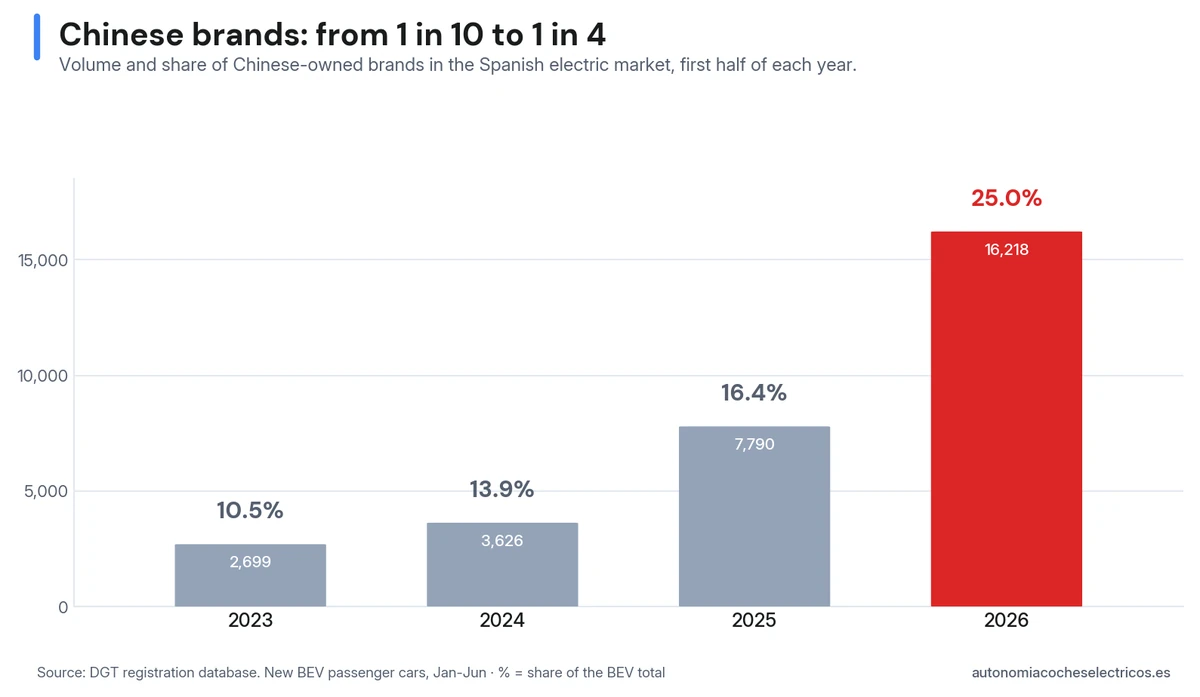
More than the figure, the variety of names supporting it has grown. Two years ago, the Chinese electric car in Spain was limited to MG and the first BYDs. Today, behind BYD, a growing group is pushing: Leapmotor, Deepal, and XPENG are already moving their own volumes, and below them, Omoda, Jaecoo, Smart, or Lynk&Co are emerging, brands that barely appeared in the data before. Each arrives in its own way —Leapmotor is brought by Stellantis, the group behind Peugeot and Fiat, while BYD or MG expand independently—, but all compete for the same entry-level buyer.
BYD plays in a different league: it alone is more than half of the entire Chinese block. Its volume doesn't come from the tide of its compatriots but from its own weight as a global competitor that competes head-to-head with Tesla on the motorway and around the world. The rest of the block adds up by the number of brands; BYD, by units.
The models that sustain the volume
Below the brands, a handful of models sustain almost all the volume. The two Teslas top the chart, and the Model 3 alone accounts for nearly one in ten electric cars for the semester. Behind them, the novelty is who occupies the high zone: a Chinese compact, and right after, a tie between a newly arrived Japanese SUV and a Korean compact.
With the two Teslas undisputed at the top, the competition starts at third place. The BYD Dolphin Surf climbs to the podium with two advantages: it's the cheapest electric car sold in Spain and the first non-Tesla model to settle up there. Just behind, the Kia EV3 and Toyota C-HR finish the semester tied. The EV3 offers more than just a competitive price: when we measured its motorway range, it was around 330 km at 120 km/h, enough for its buyer. Further down, a large sedan, the BYD Seal, stands out as the only one challenging the Model 3 in size, indicating that BYD is reaching segments where Tesla doesn't compete.
The mid-range has depth and sustains volume month by month: the BYD Atto 2, Renault 5 E-Tech, Deepal S05, Citroën ë-C3, or Škoda Elroq are reasonably priced cars from different brands that rotate positions without relying on any calendar peak. None dominate, but together they move more than the two leaders.
What the semester indicates for the second half of the year
The semester leaves two questions for the next six months. If BYD closes that 253-car gap, it would dethrone a Tesla that has led the Spanish electric market year after year since 2021. And if the Chinese block maintains the pace that brought it to 25%, it will cease to be a trend and become the market norm.
Spain is still far from countries where electric is already the majority. In Norway, 96 out of every 100 new cars are electric, the result of thirty years of public support that didn't change direction with each legislative term. Here, that push comes later and in fits and starts, as shown by the Auto+ itself, stuck for half a year in the BOE. The supply no longer hinders the transition: there are more cars, more brands, and more affordable models than ever. What is lacking is consistent support and a charging network to match.
Methodology and data source
The data in this article comes from the official registration database of the Dirección General de Tráfico (DGT), under the Ministry of the Interior of Spain.
The following filters have been applied to the raw data:
- Vehicle type: Passenger car. Vans, light commercials, trucks, buses, motorcycles, and mixed vehicles are excluded.
- Propulsion type: Battery electric (BEV). Plug-in hybrids (PHEV), hybrids (HEV), and range-extended electric vehicles (REEV) are excluded.
- New/Used: New vehicle. Used registrations are excluded.
The figures reflect registrations of new fully electric passenger cars between January and June 2026, closed as of June 30, and include purchases by private buyers, companies, and leasing.