
August is traditionally the weakest month of the year for car registrations in Spain: it was the lowest-volume month of all twelve in both 2024 and 2025, and 2026 repeats the pattern as the lowest so far this year. With dealers running at half speed and much of the country on holiday, 69,402 passenger cars of all technologies were registered, 32.5% fewer than in July. That reduced scale is worth keeping in mind through the rest of this article: the month's absolute figures are smaller than at any other point in the year, and the percentages are more sensitive.
Within that shrunken market, the electric car posted its best August ever. 9,450 new fully electric passenger cars were registered, 31.7% more than in August 2025, and the ratio set the number that defines the month: 13.6% of all new passenger cars registered were fully electric, the highest monthly share recorded in Spain to date. Nearly one in seven cars registered in August ran on a battery instead of a tank.
Note: The figures in this article are registrations of new fully electric passenger cars (BEV) in Spain during August 2026, including purchases by private buyers, companies and rental fleets. Plug-in hybrids (PHEV), used vehicles and vans are not included. The data comes from the DGT registration database (Spain's Directorate-General for Traffic), closed as of 31 August. We revised our calculation method in July 2026, so these figures are not directly comparable with articles published before then; all comparisons below have been recalculated using the new method.
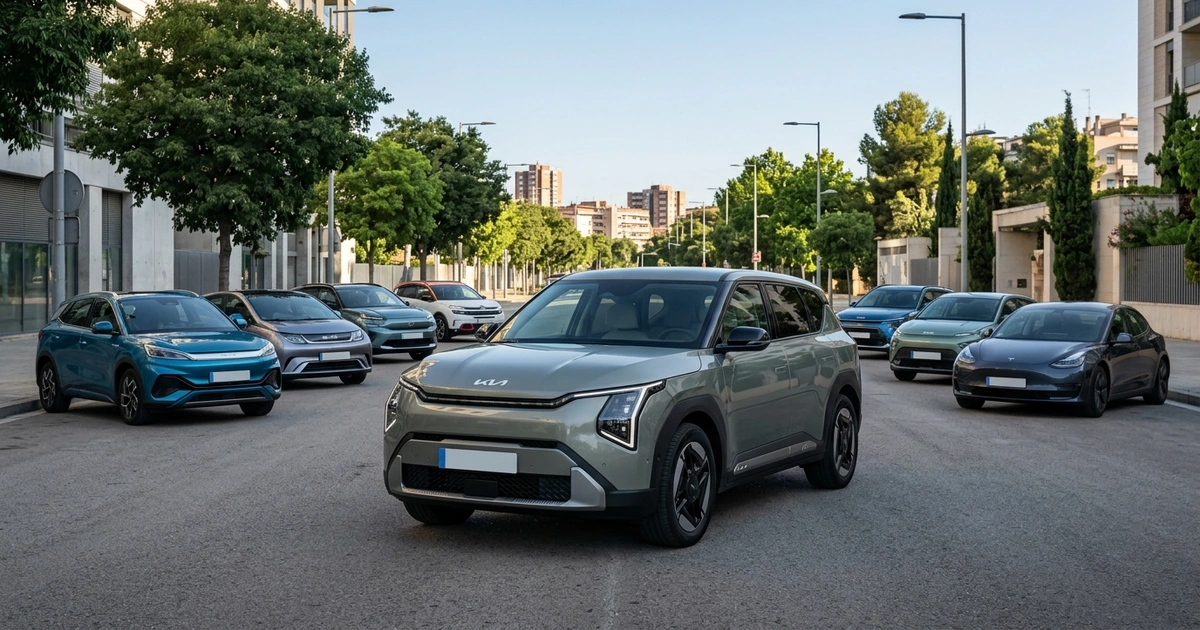
In the ranking, continuity is in charge: the Kia EV3 holds on to July's lead with 433 units, BYD repeats as the top brand, and Chinese-capital brands add up to 33.8% of sales, passing a third of the market for the first time. The exception is Tesla. In August 2025 it returned to first place after a July of very few deliveries; this year it does not repeat, finishing on 304 units and in 11th place.
In this article 8 sections
- What's behind the record 13.6% share
- The 20 best-selling electric cars in Spain in August 2026
- What private buyers choose: here the BYD Atto 2 wins
- The best-selling brands: BYD out front and Leapmotor settled on the podium
- Tesla, 11th place: deliveries bunched by quarter and a steadily smaller weight
- Where 2026 stands: a market 2.6 times bigger than two years ago
- The electric car inside the total market: the hybrid is still in charge
- Methodology and data source
01What's behind the record 13.6% share
The peak share arrives in the month when the total market hits its low. When overall volume falls 32.5% against July, any segment that weathers the summer lull better gains relative weight, and the electric car weathers it better: its registrations dropped 14.5% against July, less than half the fall of the market as a whole. Within the electric segment itself, the pause comes mostly from companies, which registered 24% fewer cars than in July, while private buyers cut their purchases by only 10%.
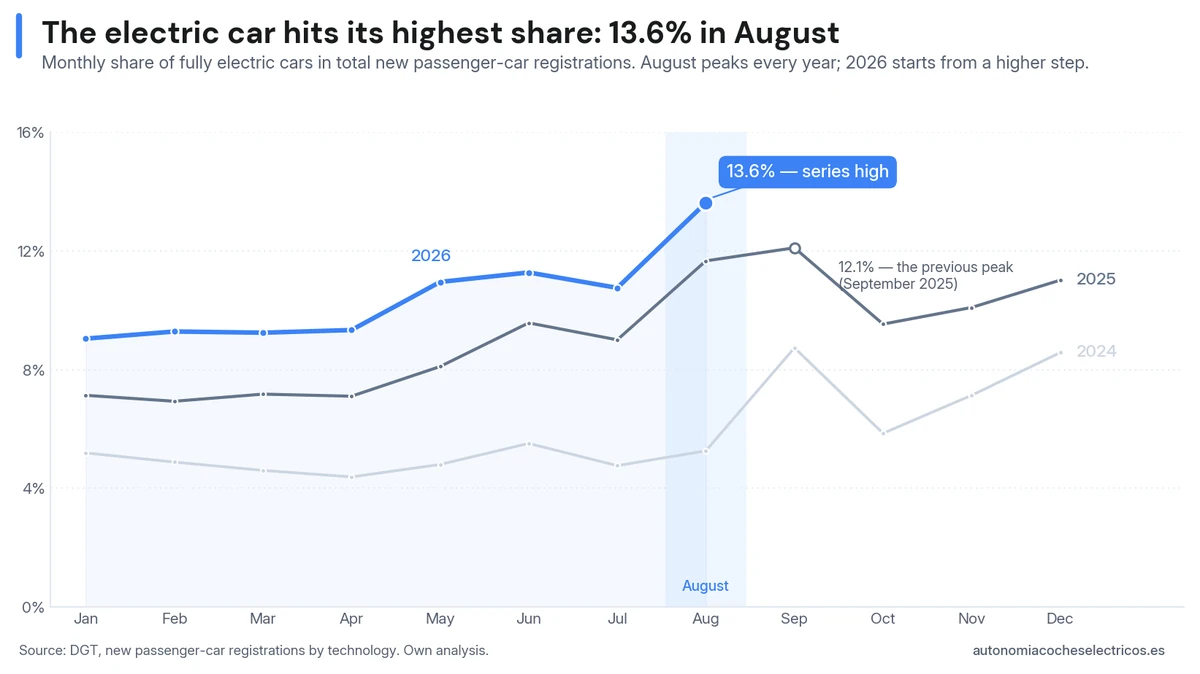
The pattern repeats every year: in 2025, August's electric share (11.7%) also cleared July's (9.0%) by a wide margin. The difference is the level. That August of 2025 landed almost two points below today's 13.6%, and the previous high for the whole series —the 12.1% of September 2025— is also beaten. In the 2026 cumulative total, where the calendar effect washes out, the average share is 10.3%, against 8.2% for the same period last year.
02The 20 best-selling electric cars in Spain in August 2026
Kia EV3, BYD Atto 2, Dolphin Surf and B10: the same four as July
The Kia EV3 marks its second month in a row as the best-selling electric car. Only three models have stayed inside the top 10 for all eight months of the year —the EV3, the BYD Atto 2 and the Dolphin Surf— and all three now hold the top three places: in a month shaped by the holiday lull, consistency counts for more than delivery spikes. The Leapmotor B10 completes the leading quartet, dropping two spots against July but holding a volume —332 units— that was unthinkable for the brand back in January.
August brings no debuts either: after July's five newcomers, no model registered its first units this month.
Who rises and who falls inside the table
Below the leaders, August moves in both directions. Rising are the Škoda Elroq, which posts its best month of 2026 with 284 registrations after a steady climb from 108 in January; the MG4 Urban, which sets a high of 182 units barely four months after going on sale; and the Geely E5, which strings together three months of growth (86 in July, 131 in August) and lands just outside the top 20.
Falling are the Toyota C-HR+ and the Deepal S05. The first adds 291 units, far from the 831 of its April peak: with the launch backlog worked through, it is settling toward its stable volume. The second links two months of decline (390 in June, 337 in July, 235 in August) after half a year of continuous growth.
The ninth-place BYD Seal: three in four go to company names
The BYD Seal reappears near the top with 242 units, 183 of them —75.6%— registered by companies: the highest corporate share in the entire top 10. It repeats the pattern of its June peak, when it recorded 497 units with a 90% company channel. BYD's saloon moves on corporate deals, and it does not appear among the top twelve in the month's private-buyer ranking.
03What private buyers choose: here the BYD Atto 2 wins
The breakdown by buyer type delivers one of the month's key figures: 6,565 of the 9,450 registrations (69.5%) go to private individuals, one of the highest shares of the year, behind only June's 69.7%. And with the lens set on personal purchases alone, the ranking changes leader.
The Kia EV3 wins the month overall, but one in four EV3s goes to a company name; the BYD Atto 2, with almost 89% of its sales in personal names, overtakes it once we count private buyers alone. The right-hand column draws the pattern: the lower-priced electrics —the B10, the ë-C3, the MG4 Urban— live almost entirely off the private buyer, while models with a larger fleet presence split their volume between the two channels.
The comparison with previous Augusts shows a deeper shift in who buys electric. Private individuals signed 55% of August's electric registrations in 2023, 60% in 2024 and 68% in 2025. Three years ago, companies put nearly half of the month's electric cars on the road; today, seven in ten are personal purchases.
04The best-selling brands: BYD out front and Leapmotor settled on the podium
BYD strings together its second month as the top brand, with 1,357 units and 56% more than Kia. Its formula does not change: three models in the top 10 and a presence across almost every price bracket, so that no month rides on a single best-seller. The European volume brands hold up well: Volkswagen climbs to fourth with 555 registrations —its ID.4 posts 185— and Škoda leans on the Elroq's best month to take eighth.
Leapmotor: from 15th in January to a fixture on the podium
The year's steadiest climb has a name of its own. Leapmotor opened 2026 as the 15th brand with 165 monthly registrations; in May it broke into the top 10, in June it moved up to ninth, and in July and August it has been third. Its 600 August units are four and a half times the 132 of August 2025. The rise has been built month by month, with the B10 as the engine and the small T03 adding steady volume below it.
The Chinese block passes a third of the market for the first time
Chinese-capital brands reach 33.8% of the electric market in August: their highest share to date, after July's 32.8%, and the first time they clear a third of the market —though the record is partly shaped by the collapse in Tesla's registrations. Throughout the first half of the year, that block moved in a band between 23% and 28%.
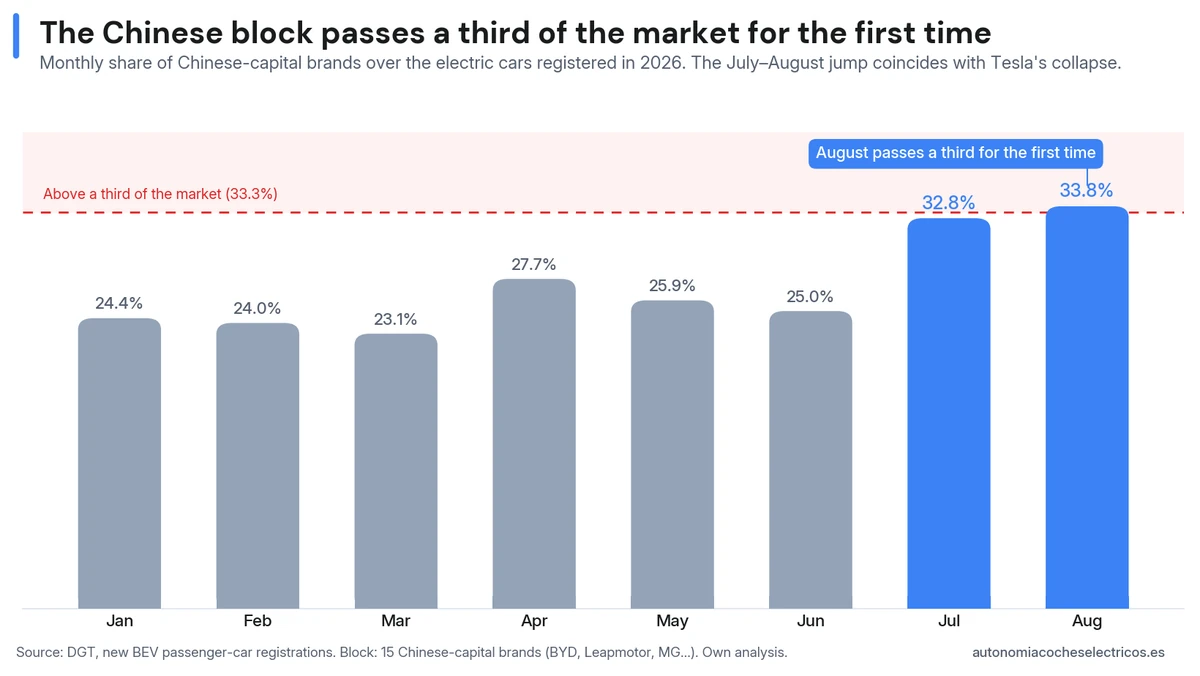
Part of the jump is explained without the Chinese brands selling more. The block registered fewer units in August (3,196) than in June (3,642), and its share still rose from 25.0% to 33.8%, because the market it is measured against is much smaller without Tesla's deliveries: Tesla registered 2,784 cars in June and 304 in August. With that volume out, the same Chinese sales weigh more. The comparison that avoids that effect is year on year: in August 2025, with Tesla as the month's top brand, the Chinese block held 24.1%; a year later, almost ten points more.
05Tesla, 11th place: deliveries bunched by quarter and a steadily smaller weight
Tesla has always concentrated much of its registrations at the end of each quarter —March, June, September and December, the months when it closes its books— and that produces sharp monthly swings without any change in demand. What is different in 2026 is the result that swing leaves behind: in August 2024 and 2025, even with few deliveries, Tesla was the month's top electric brand; this August it finishes on 304 units, in 11th place and 79% below a year ago. More than half of its 2026 registrations —54%— are concentrated in just two months, March and June.
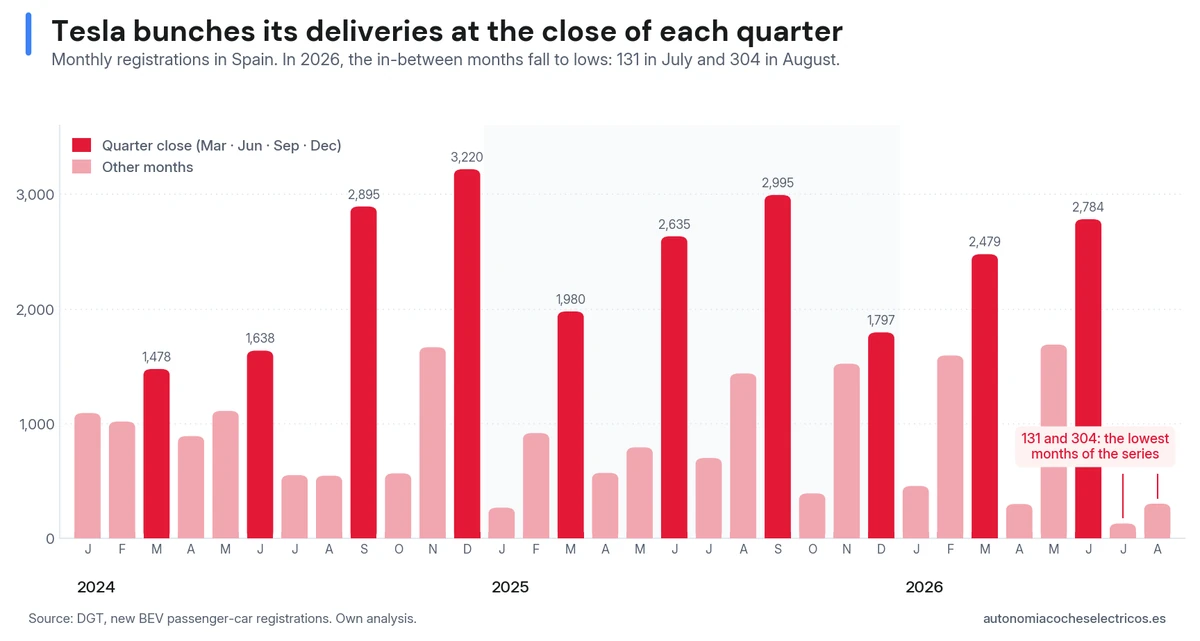
The annual series completes the diagnosis. Tesla is not registering fewer cars than before in absolute terms: its 9,744 registrations between January and August are its best figure in Spain for this period, above the 9,311 of 2025. What has changed is the market around it: in 2024 those numbers were around 25% of the electric cars registered; today they are 11.4%. The market has multiplied 2.6 times in two years, and Tesla —with a Spanish electric range cut to two models against the wave of Korean, Chinese and European launches— has gone from defining the Spanish electric market to being one more brand within it.
06Where 2026 stands: a market 2.6 times bigger than two years ago
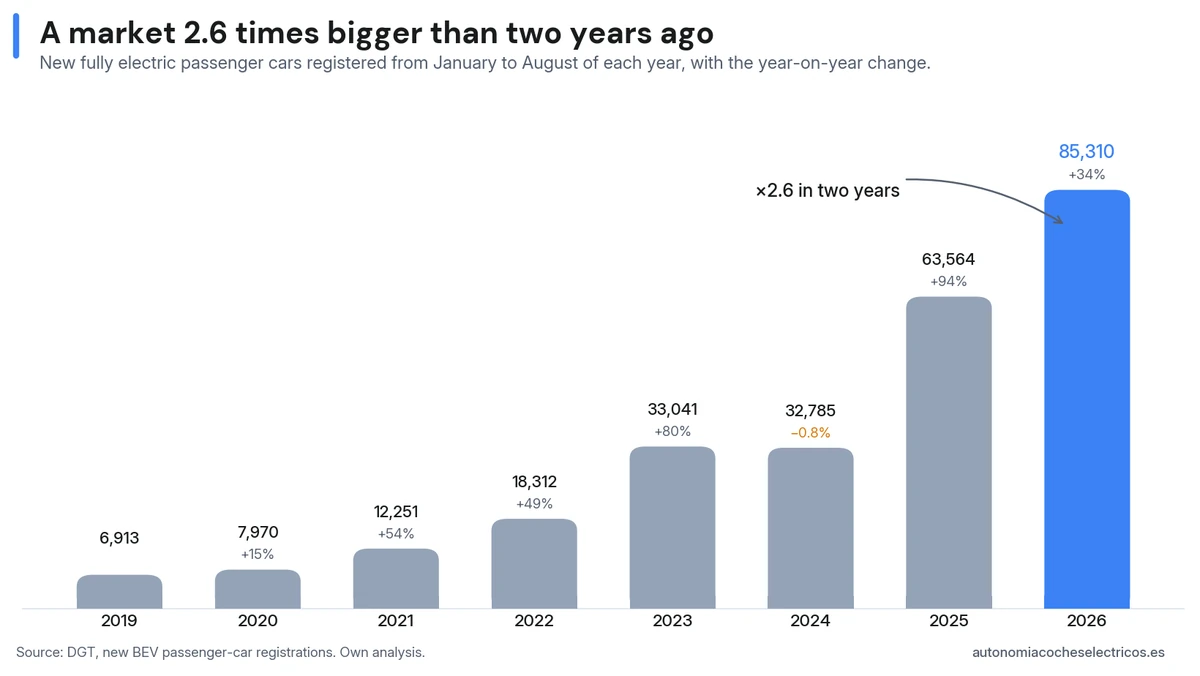
Between January and August, 85,310 new electric passenger cars were registered, 34.2% more than the 63,564 of the same period in 2025. The pace is slower than the +94% that the same period of 2025 posted over 2024, but the growth in units —nearly 22,000 more— is comparable to the entire jump of 2023, which had been the benchmark until now. The long view places the moment: in the same period of 2024, 32,785 electric cars were registered, so the market has multiplied 2.6 times in just two years, after a 2024 in which this same cumulative total briefly fell 0.8%.
In the annual standings, Tesla's thin July and August deliveries keep fattening BYD's lead: the Chinese brand heads 2026 with 11,937 registrations against Tesla's 9,744, a gap of 2,193 units that has nearly doubled over August. Among models there is no change of leader: the Tesla Model 3 remains the year's best-selling electric car by a comfortable margin.
07The electric car inside the total market: the hybrid is still in charge
Let's step out of the electric ranking to look at the whole market. Of the 69,402 passenger cars registered in August, the non-plug-in hybrid remains the majority choice with 45.7%. The plug-in hybrid (PHEV) posts 13.8% and edges ahead of the pure electric by a razor-thin margin: 9,587 units against 9,450. And unassisted combustion continues its retreat: pure ICE cars —petrol plus diesel— fall from 30.3% in August 2025 to 22.5%.
Adding up everything that plugs in —electrics, plug-in hybrids and extended-range electrics: 19,177 cars in total— 27.6% of the passenger cars registered in August arrive with a cable, against 23.9% a year ago. More than one in four new cars now charges from a socket, though only half of them drop the tank altogether.
August leaves a rather different picture from the one the Spanish electric market offered two years ago. The BEV already makes up 13.6% of passenger cars registered in a traditionally weak month, the private buyer accounts for almost seven in ten transactions, and BYD leads the year ahead of Tesla. What matters is not who wins a holiday month: it is that the electric market has reached a size where Tesla, which set the segment's pace for years, can no longer steer it on its own.
08Methodology and data source
The data in this article comes from the official registration database of the Directorate-General for Traffic (DGT), part of Spain's Ministry of the Interior.
The following filters were applied to the raw data:
- Vehicle type: Passenger car. Vans, light commercials, trucks, buses, motorcycles and mixed-use vehicles are excluded.
- Powertrain: Battery electric (BEV). Plug-in hybrids (PHEV), hybrids (HEV) and extended-range electrics (REEV) are excluded.
- New/Used: New vehicle. Second-hand registrations are excluded.
- Chinese block: groups the brands controlled by Chinese business groups (BYD, Leapmotor, Deepal, XPENG, MG, Omoda, Jaecoo, Lynk & Co, Smart and Geely, among others), regardless of where the vehicle is built. It is therefore not equivalent to "cars made in China." It does not include KGM (Korean) or DS (French).
- Purchase channel: the main ranking includes all registrations (private buyers, companies and rental fleets). The private-buyer breakdown is calculated from the same DGT database, filtering registrations in the name of a private individual.
The figures reflect registrations of new fully electric passenger cars during August 2026, with data closed as of 31 August 2026, and include purchases by private buyers, companies and rental fleets. Comparisons with earlier months and years are recalculated using the same method on the full dataset, so they may differ slightly from figures published in earlier articles. Market-share figures against the total passenger-car market come from the same source, covering all powertrain technologies.