

In 2025, 49,003 ownership changes of fully electric cars were registered in Spain: almost three times more than four years earlier, and a figure that in the first half of 2026 grew another 54% compared to the same period last year. The used electric car market is now a significant sector in Spain.
There's a statistic that addresses the most common fear when buying one. The used electric car that changes hands is younger than you might think: it is resold on average at 2.8 years, and nearly six out of ten do so before reaching three years. The car that most people buy second-hand in Spain is still far from being a "worn-out old battery."
All figures come from the transfers of fully electric cars registered with the DGT: the changes of ownership of an already registered car, not new car registrations. We look at the last full year (2025) and the first seven complete months of 2026; the registration cut-off is August 6, so the entire month of August is excluded.
Beyond the volume, the list offers another perspective: what is sold and at what age. And here, two very different markets coexist.
The used electric market now has its own volume
The annual series shows it at a glance. In 2015, 1,326 electric cars were transferred across Spain; by 2020, it was 8,111; in 2021, it surpassed seventeen thousand for the first time, and in 2025 it reached 49,003. In a decade, the second-hand electric market has multiplied by thirty-seven.
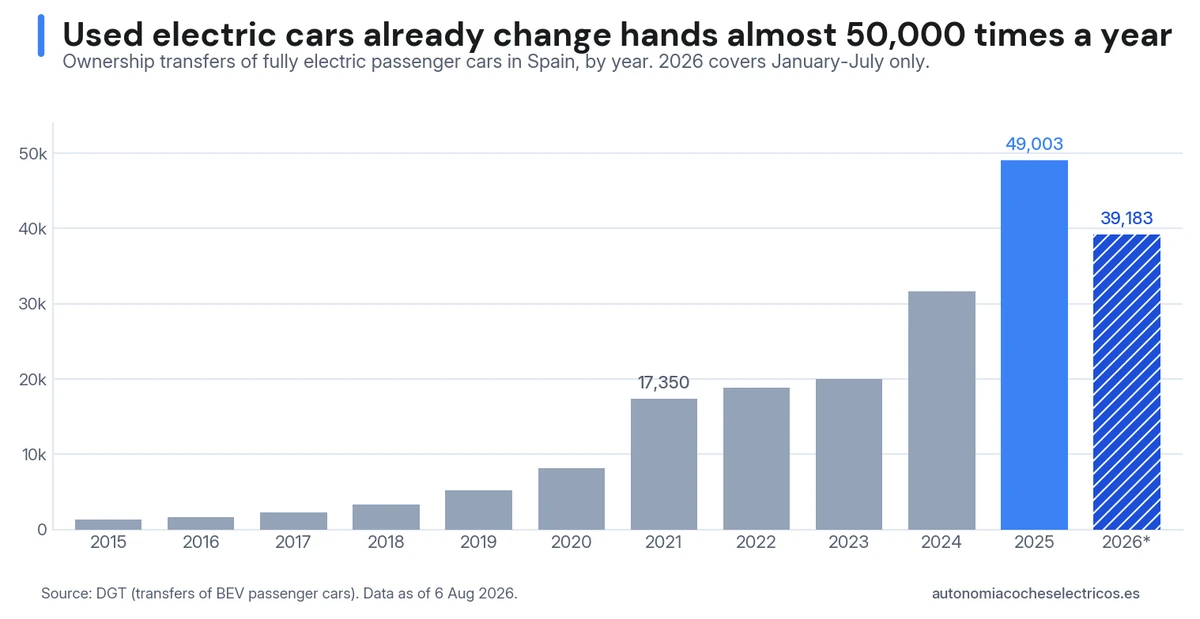
The leap in the last two years is the most striking: from 31,591 transfers in 2024 to 49,003 in 2025, a 55% increase in just one year. And 2026 is on track to surpass it comfortably: between January and July, 39,183 ownership changes have already been registered, compared to 25,293 in the same period of 2025, a 54.9% increase. Comparing only the first two semesters —January to June— the growth is almost identical, at 54.3%.
This growth has a simple explanation: for there to be used cars, there first have to be new cars. The wave of electric registrations in 2021 and 2022 is now reaching the second-hand market, and each passing year increases the available stock. The used market is, fundamentally, the echo of the new market with a few years' delay.
Who buys has also changed. In 2025, 52% of the transfers were in the name of a private buyer; four years ago, in 2021, it was barely half that proportion. More and more used electric cars end up in the hands of a private buyer, not a company.
It's younger than you fear
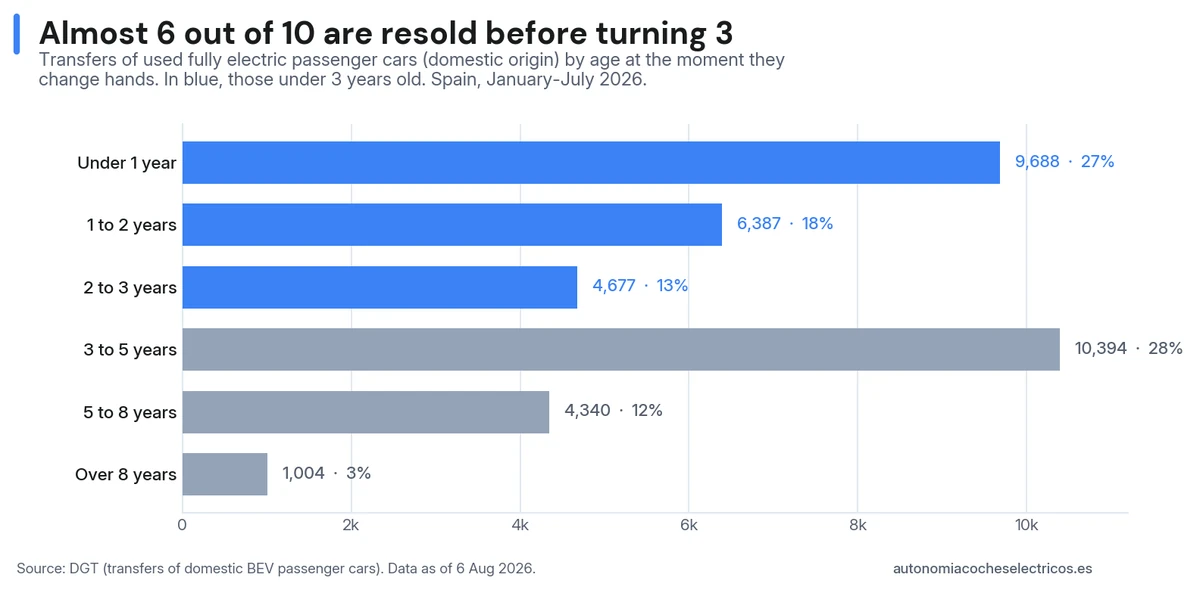
Here's the data that should most reassure those considering a used electric car. Of the transfers of domestically sourced cars registered between January and July 2026, the majority correspond to cars that have just recently been registered in Spain. The average age at change of hands is 2.8 years, and the median is even lower, around two and a half years.
Distributed by age brackets, the pattern is clear:
Fully electric cars of domestic origin. Source: DGT. Percentages sum to 100 except for rounding.
Almost six out of ten used electric cars change owners with less than three years, and only one in thirty-six —2.8%— is over eight. The typical used electric car you buy in Spain is still within the manufacturer's battery warranty, which usually covers eight years.
This matters because the most widespread fear —"the battery will be very worn out"— is based on a premise that doesn't hold. Most of these cars are nearly new, moving from a first to a second owner with very few years on them, far from the scrapyard. How much a battery degrades in that time is another conversation, deserving its own analysis with health status data; the registry only indicates that age is rarely the issue.
What is bought: the second-hand ranking
These are the electric cars that changed hands the most in Spain between January and July 2026, with the average age at which they were transferred and the percentage that went to a private buyer.
Transfers of fully electric cars, January-July 2026. Source: DGT.
The Tesla Model 3 leads, with nearly two thousand transfers and a strong private profile: three out of four changes end up in the hands of an individual. It has been among the best-selling new electric cars in Spain for years, so it has the largest stock from which a used car can emerge. Behind it are a German premium, an affordable utility, and an urban icon, in that order, showing how varied this market already is.
A word of caution about the names. Models like the Dacia Spring, the Fiat 500e, or the MINI Cooper are still sold new today, so they have technical specifications on the website, and you can check their measured range and data. The first-generation Renault Zoe or Nissan Leaf you see in the table, however, are no longer sold as new cars: they are purely second-hand market, and their figures come only from the transfer registry.
Two worlds in the same ranking
If you look at the age column, the list splits into two groups that have almost nothing in common.
On one side are the mature veterans: the Renault Zoe and the Nissan Leaf change hands at an average of 6.5 years, and the smart fortwo at 5.4. These are the first wave of electric cars, urban vehicles bought at the beginning of the last decade that are now in their second or third life, almost always among private buyers. Here, the word "used" means what it has always meant: a car with a history.
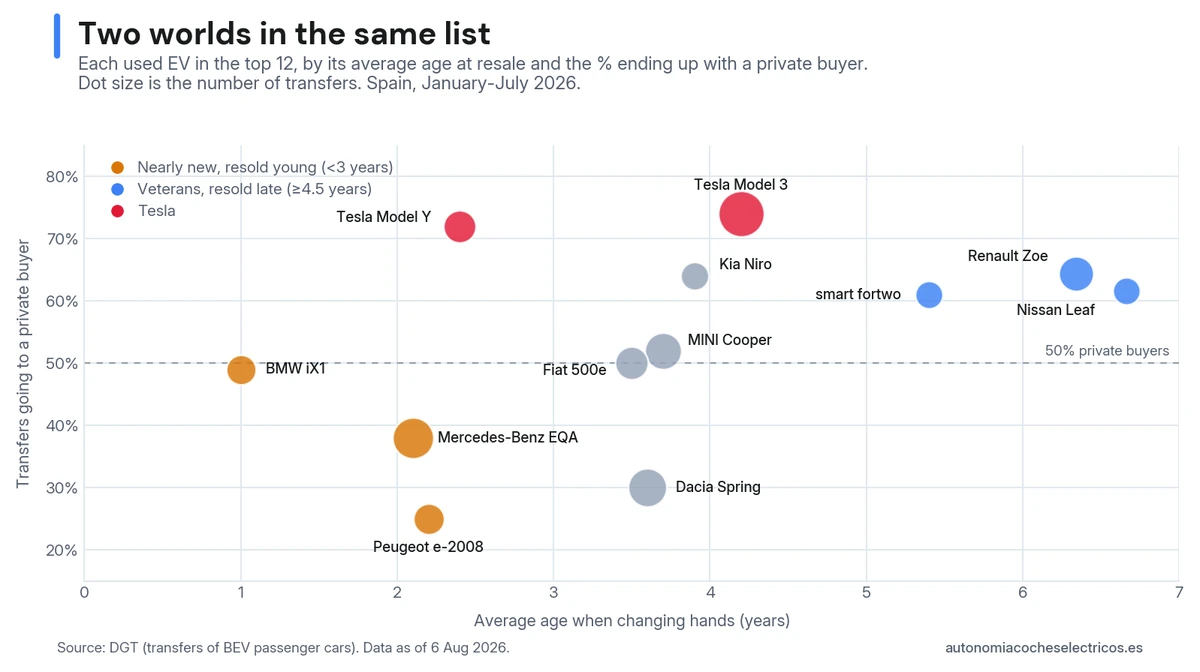
On the other side are the premium nearly-new, which rotate much sooner. The Mercedes-Benz EQA is transferred at an average of 2.1 years, the Tesla Model Y at 2.4, the Peugeot e-2008 at 2.2, and the BMW iX1 with barely one year. These are almost new cars that are already changing owners.
The key to understanding that second group is in the last column. The EQA is one of the few on the list whose buyer is mostly a company —only 38% of transfers end up with a private buyer—, and the pattern repeats with the e-2008 (25%) or the iX1 (49%). The registry only distinguishes whether the recipient of the car is an individual or a company; it doesn't specify what type of company. That a car rotates so young and mainly towards business buyers fits the cycle of the company car —leasing, resales, and companies that relocate after one or two years—, although the data alone doesn't certify it. That channel, the electric as a company car, has its own logic, and we've covered it in detail elsewhere.
The practical consequence for the buyer is direct: a used Zoe and a used EQA are different operations even if they're on the same list. The former is a mature car that has been on the road for years; the latter, a nearly-new vehicle that often comes from the business channel. Knowing which of the two worlds the car you're looking at comes from changes what you can expect from it.
What this means for you
The second-hand electric market in Spain is now large enough and young enough to be taken seriously. Almost 50,000 cars are transferred each year, growing at a double-digit rate, and most are cars with few years on them.
The registry doesn't tell you how much the battery of the specific car you're looking at has degraded, nor at what price each transaction is closed: other sources are needed for that. What it does make clear is the starting point. The average used electric car is around three years old, and the market in which you would buy it is growing in size every month.
This is the first piece in a series on second-hand electric cars built entirely with the DGT transfer registry. In the following articles, we'll delve into the details: which models withstand the transition from first to second hand better, how each channel behaves, and what the figures say about how a second-hand purchase decision is made.