
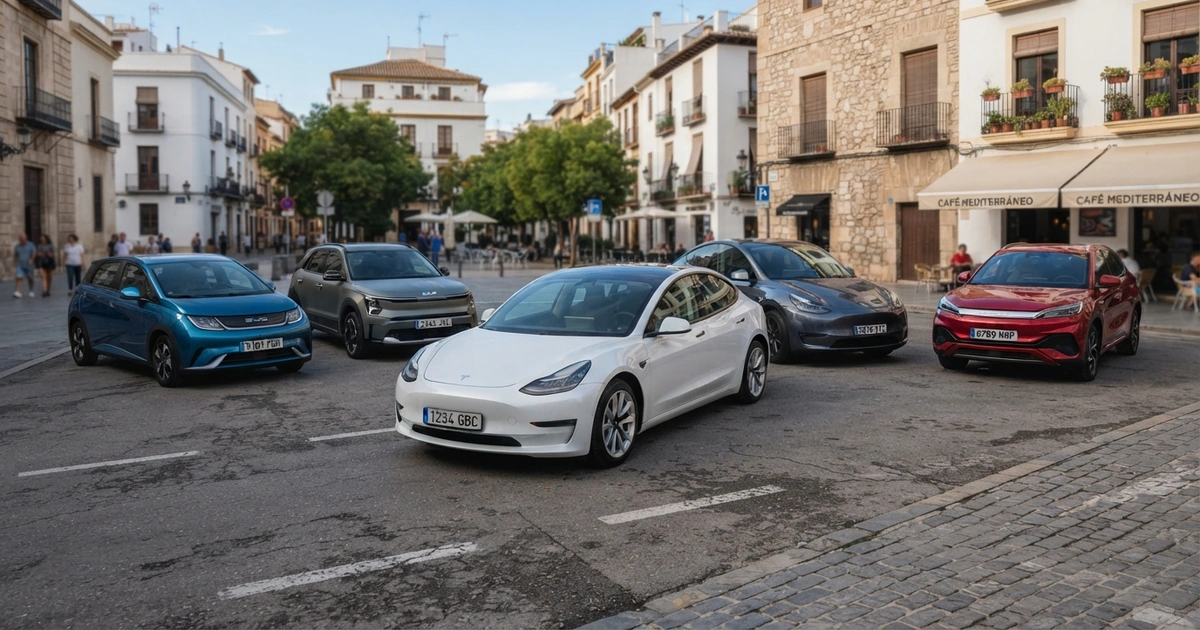

Nearly one in five new passenger cars registered in Spain in September 2026 was fully electric. The electric car's market share reached 18.6%, five points above August's 13.6%, which had been the previous high, and six and a half points above the 12.1% of September 2025. It is the highest monthly weight the electric car has ever had in the Spanish market.
In units, September is the month with the most registrations of fully electric passenger cars ever recorded in Spain: 17,649, 70.8% more than in September 2025 and 21% more than in June, the previous record. The overall market also grew —94,661 passenger cars of all technologies, 10.9% more than a year ago— but far less, and the share comes out of that gap.
Tesla returns to first place after two months outside the top 10, with 3,736 units and the Tesla Model 3's best month ever in Spain (2,529): this is the quarter-end month in which the brand bunches its deliveries. Twenty models with more than a hundred registrations set their monthly record in September, and five of them registered their first units between late June and August.
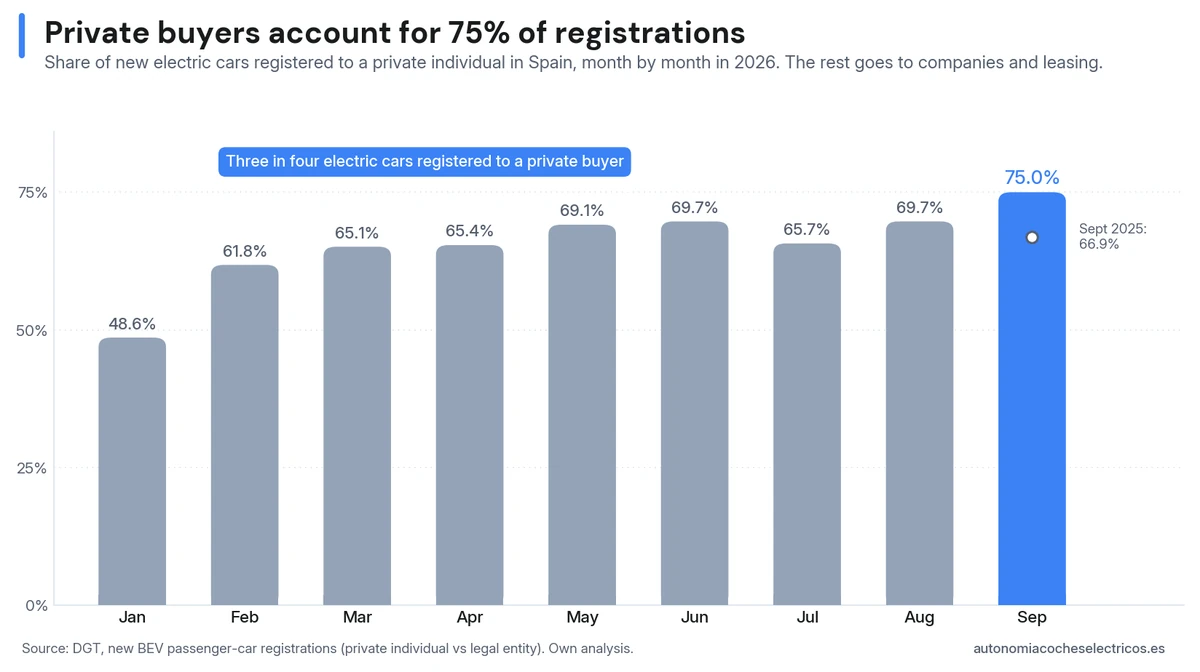
Two more figures complete the picture. 75% of registrations are in the name of a private individual, the highest proportion of 2026, and Chinese-capital brands hold 33.6% of the market despite Tesla's return to the top: the third they reached in August, when Tesla barely delivered, no longer depends on its absence.
What's behind the 18.6%
A record share in September is partly a matter of the calendar. Tesla bunches its deliveries at the close of each quarter, and the Septembers of 2024 (8.7%) and 2025 (12.1%) were already the months with the highest electric share of their respective years. What is new in 2026 is the size of the jump: that 12.1% was the ceiling of the whole series until August, and a year later the same month beats it by six and a half points.
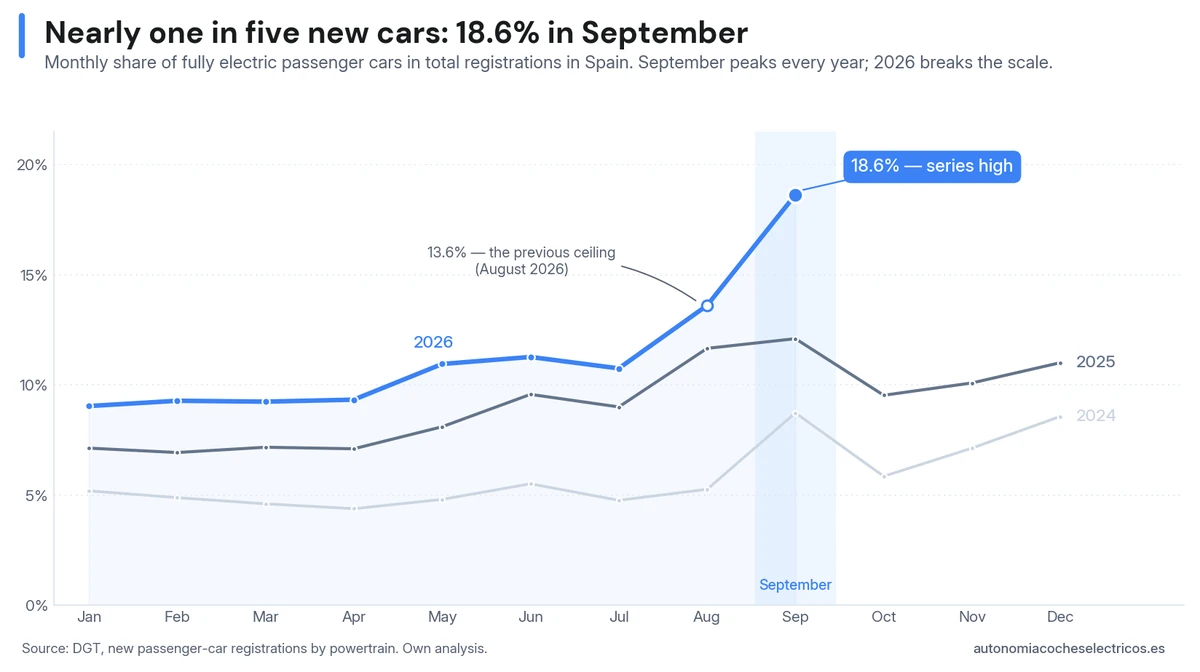
That jump has three components we can measure. The first is Tesla, which goes from 2,995 units a year ago to 3,736 (+24.7%). The second, much larger, is everything else: brands other than Tesla go from 7,337 to 13,913 registrations, almost 90% more. The third is supply: ten of the twenty models that set a monthly record in September were not on sale in Spain a year ago.
There is a fourth factor the DGT database cannot measure. The Plan Auto+ incentive for private buyers has been open for months and, according to industry estimates without official confirmation, had committed around half of its budget by mid-September.
It is possible that some buyers brought their purchase forward to file the application before the Plan Auto+ money runs out. The ministry does not publish the pace of applications, so that effect cannot be quantified.
The last day of the month: 2,707 registrations and four Teslas
On 30 September, 2,707 electric cars entered the DGT register, 15.3% of the month in a single day, and between the 28th and the 30th, 5,357 (30.4%).
This is the usual end-of-month bunching in the sector, somewhat more pronounced than in the two previous Septembers (22.5% in the last two days of 2025; 18.6% in 2024), and this time without Tesla: the brand registered 89% of its units before the 21st and only 17 between the 29th and the 30th.
The push at the close comes from BYD (868 units in those two days), Leapmotor (364), Kia (307) and Geely (292). 66% of what was registered on the 30th is in the name of a private individual, so the spike is explained more by customer deliveries than by dealer self-registrations.
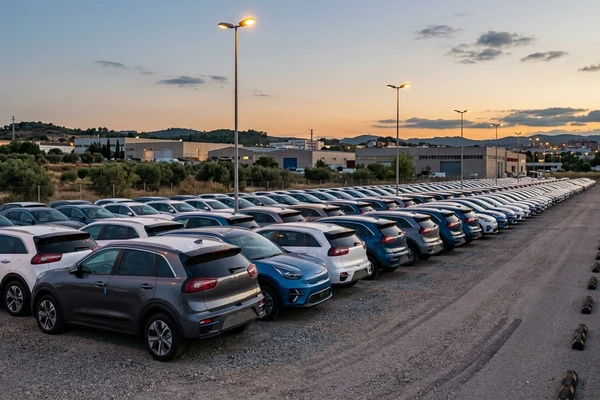
The 25 best-selling electric cars in Spain in September 2026
Model 3 and Model Y: the best month for both in Spain
The Tesla Model 3 adds up 2,529 registrations, above the 2,447 of December 2024, its previous high, and 28% more than in September 2025. The Model Y does the same with 1,207 (+18.7%). Between them they take 21.2% of the month: one in five electric cars registered in September is a Tesla, and the Model 3 quadruples the registrations of the third-placed model.
This is the peak of the quarterly batch, not the average: in July and August combined the brand had registered 435 units.
Geely, Leapmotor and the newcomers entering the table
September's news sits between 9th and 22nd place. Geely places two models back to back: the E5, a compact SUV that registered 131 units in August and 383 in September, and the E2, a small hatchback that in its second month on sale goes from 52 to 371.
Leapmotor puts four models in the top 21: the B10 is still its best seller (486, its high), but the B05 —290 in its fourth month— and the B03X —231 in its second— already add up to more than the B10. The T03 repeats 290, also its best figure.
Outside the Chinese block there are records too. The Renault Twingo almost doubles its summer average and reaches 305 units, 96% in the name of private buyers. The Volvo EX30 posts 307, its best month since it went on sale in Spain (the previous high was 209). The Volkswagen ID.3 Neo climbs to 223 in its fourth month and the Mazda CX-6e to 170 in its third. The electric Mercedes-Benz C-Class debuts with 45 registrations.
Who falls: the EV3 loses the lead while growing
The Kia EV3 had won July and August; in September it registers more than in either of those two months (558 against 454 and 433) and still drops to fourth place. The BYD Dolphin Surf, third with 625, is in the same position: its best month of 2026 and far from the 847 of October 2025. In a month when the market grows 87% over August, holding your position takes much more than holding your volume.
Declines in units are few. The Škoda Elroq goes from August's 284, its 2026 high, to 221; the Citroën ë-C3, from 303 to 215; and the Cupra Raval strings together its third decline in a row (478 in June, then 231, 104 and 98). The BYD Atto 3 EVO makes the opposite move: from 141 to 535, almost four times more, and enters the top 5 for the first time.
What private buyers choose: 75% of the month
13,245 of the 17,649 registrations (75.0%) are in the name of a private individual, the highest percentage of 2026 and of any September: in 2023 it was 38.9%; in 2024, 62.6%; in 2025, 66.9%. The month's year-on-year growth comes, above all, from private buyers: their registrations rise 91.5% (from 6,915 to 13,245), against 28.9% for legal entities (from 3,417 to 4,404).
Unlike August, the private-buyer ranking does not change leader. And it clarifies the profile of the Tesla buyer in Spain: nine out of ten Model 3s and Model Ys are in the name of a private individual, with 138 units on leasing between the two models. The more affordable electric cars —Atto 2, B10, Twingo— stay above 90% personal purchases.
The company channel is concentrated in a few models and, within them, in professional uses. The BYD Seal repeats the pattern of June and August: 268 units, 75% in the name of a company, and 193 of them —72% of the total— are chauffeur-driven hire vehicles (VTC, Spain's ride-hailing licence).
The Geely E5 looks more like the Seal than its smaller sibling: half of its 383 units are company registrations and 164 are VTC, while the E2 is a private buyer's car (78%). In the German premium segment the split flips: only 18% of Mercedes-Benz GLCs and 29% of CLAs are personal purchases.
The best-selling brands: Tesla, BYD and Leapmotor on the podium
Tesla wins the month, BYD is second with 2,290 units (+30% year on year) and Leapmotor repeats on the podium for the third month in a row with 1,412, eight times the 171 of September 2025. Kia drops to fourth place while growing 64% against a year ago, and Mercedes-Benz is fifth with 773, with the GLC and GLB at record highs and the electric C-Class just launched.
The comparison with the top of September 2025 measures the change: back then the top five were Tesla, BYD, Kia, Hyundai and Ford; today, Hyundai is fourteenth with 360 units and Ford has dropped out of the top 15.
Geely: from 183 to 754 in one month
The month's sixth brand sold nothing in September 2025. Geely registered its first 36 units in April 2026, went from 86 in July to 183 in August, and in September multiplies by four to 754.
Leapmotor needed from September 2025 to July 2026 to go from 171 to 779 monthly units; Geely has gone from 36 to 754 between April and September, with the caveat that part of the E5's volume comes from VTC fleets.
The Chinese block holds a third even with Tesla back on top
Chinese-capital brands add up to 5,926 registrations, 33.6% of the electric market. August's 33.8% had an explanation outside the block: Tesla, which is not part of it, registered only 304 units, the market shrank and the same Chinese sales weighed more on a smaller total. In September Tesla regains first place with 3,736 units and the Chinese block gives up barely two tenths of a point, because its volume has grown at the same pace as the market: 2,351 units a year ago (when it weighed 22.8%), 3,194 in August and 5,926 now.
What has changed is the internal split. BYD is still the largest Chinese brand (2,290), and Leapmotor (1,412), Geely (754), Deepal (384) and XPENG (338, the month's sixteenth brand) together add up to 2,888 units, more than BYD. Chinese brands excluding BYD account for 20.6% of the market (19.4% in August); during the first half of the year they never passed 12.5%.
Tesla wins the month and loses the quarter
September's 3,736 follow Tesla's calendar: the brand groups its deliveries in the last month of each quarter and leaves the two previous ones almost empty (131 in July, 304 in August). The difference between one month and the next is a matter of calendar, not demand, so Tesla has to be read by quarters —we covered the mechanism in depth in April, when the brand fell to 12th place—. And read by quarters, the picture is different.
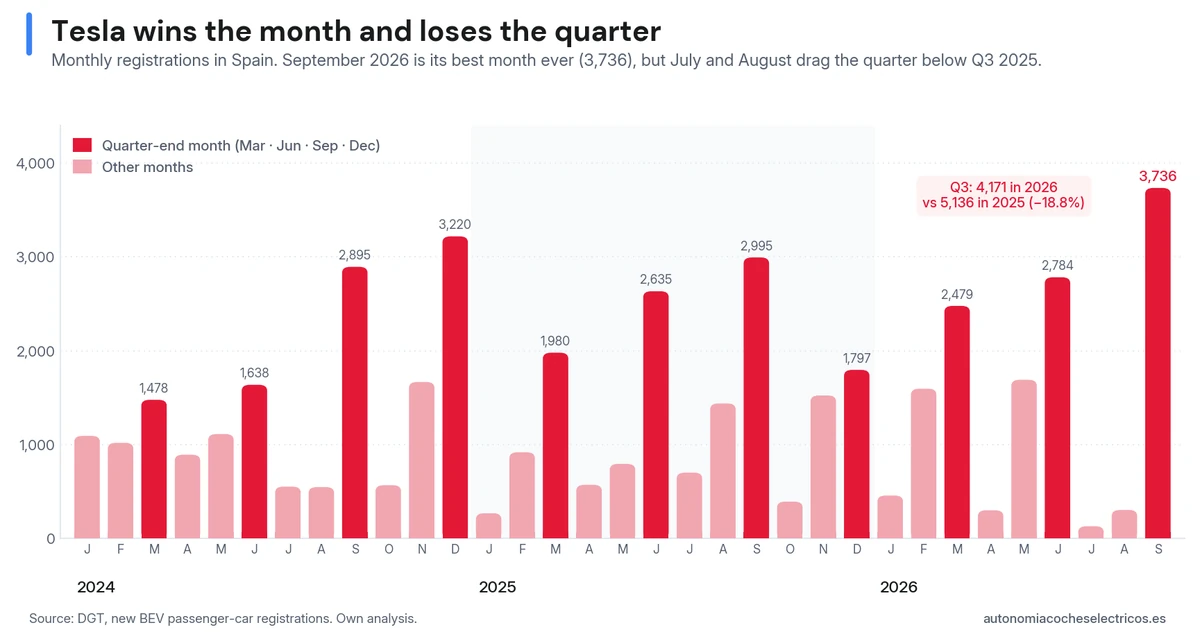
Between July and September, Tesla registered 4,171 units: 12.7% fewer than in the previous quarter and 18.8% fewer than in the third quarter of 2025, while the electric market —11,058 registrations in July, 9,447 in August and 17,649 in September— grew 3.3% and 44% in those same comparisons. Its quarterly share has fallen from 19.4% a year ago to 10.9%. The brand's best month in Spain does not make up for a quarter in which it sold less than three months ago and less than a year ago.
The same pattern shows in September: Tesla accounted for 45.3% of the electric cars registered in September 2024, 29.0% in 2025 and 21.2% in 2026. It sells more units each year in its strong month and weighs less and less, because the market around it grows faster. In the January-to-September total, its 13,480 registrations are 9.5% more than in 2025 and 13.1% of the market, against 16.7% last year.
The race for the year remains open. After August, BYD led Tesla by 2,193 units; September cuts the gap to 747 (14,227 against 13,480). The fourth quarter will decide: October, the first month of a quarter, has brought few Tesla deliveries in each of the last two years (393 units in 2025, 568 in 2024) and December, many (1,797 in 2025, 3,220 in 2024). BYD, meanwhile, has not dropped below 1,000 monthly units at any point in 2026.
Where 2026 stands: 102,955 in nine months, almost all of 2025
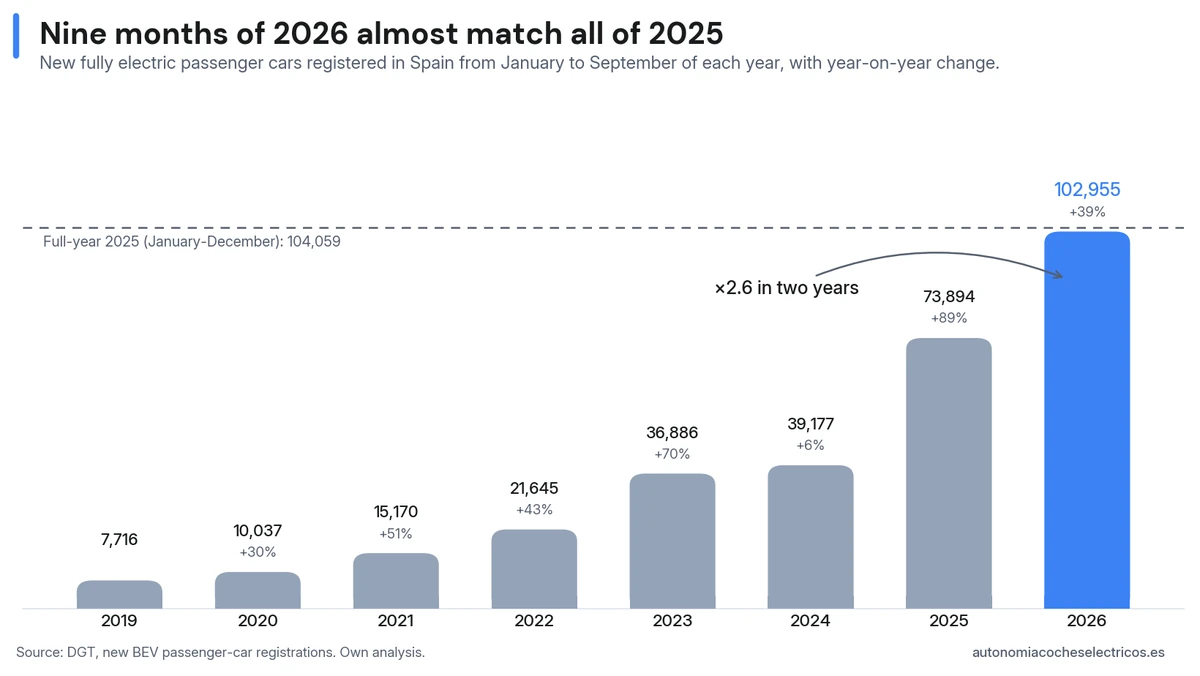
Between January and September, Spain adds up 102,955 new electric passenger cars registered, 39.3% more than the 73,894 of the same period in 2025. The reference that best places the figure is last year as a whole: 2025 closed with 104,059 registrations, and as of 30 September 2026 only 1,104 are missing to match it. At September's pace, that is two days of October.
The long series shows the change of scale. The same period of 2024 closed with 39,177 electric cars: the market has multiplied by 2.6 in two years, and the cumulative January-to-September share has gone from 5.3% in 2024 to 8.6% in 2025 and 11.2% in 2026. This year's growth, 29,061 more units, is only below the 2025 jump (34,717), which started from an almost flat 2024.
Among brands, Leapmotor is sixth with 4,597 units, 66 behind Renault, and with a monthly pace that doubled the French brand's in September. Among models, the Tesla Model 3 has opened up, with September, a lead of almost 3,500 units over the runner-up, which is the other Tesla.
The electric car within the total market: it overtakes the plug-in hybrid
Of the 94,661 passenger cars registered in September, the non-plug-in hybrid remains the majority with 42.5%. The change is on the second step: the fully electric car (18.6%) overtakes the plug-in hybrid (14.9%) for the first time in 2026, and does so by 3,524 units. From January to August the PHEV had always been ahead, although in August by only 139.
Pure combustion cars —petrol and diesel with no electrification at all— are left with 20.0%, against 30.0% in September 2025: ten points less in a year.
Adding up everything that plugs in —electric cars, plug-in hybrids and range-extender electric cars: 32,067 passenger cars—, 33.9% of September's registrations come with a cable, against 23.9% a year ago. One in three new cars already charges from a socket and, for the first time this year, more than half of those vehicles are fully electric.
October will tell whether September was a calendar peak or a new level, and there are two figures to watch. The first is the market without Tesla: if, in a month without a quarter close, it stays above 10,000 units (in July it was 10,927 of the 11,058 total, the best figure so far), September's level has a base of its own. The second is the 75% of private buyers, which may move depending on what happens with the Plan Auto+ budget.
What September has already fixed is the scale: only 1,104 units are missing for 2026 to match the electric registrations of all of 2025, with three months still to add.
Methodology and data source
The data in this article comes from the official registration database of the Directorate-General for Traffic (DGT), part of Spain's Ministry of the Interior.
We applied the following filters to the raw data:
- Vehicle type: Passenger car. Vans, light commercial vehicles, trucks, buses, motorcycles and mixed-use vehicles are excluded.
- Powertrain: Battery electric (BEV). Plug-in hybrids (PHEV), hybrids (HEV) and range-extender electric vehicles (REEV) are excluded.
- New/Used: New vehicle. Second-hand registrations are excluded.
- Chinese block: groups the brands controlled by Chinese business groups (BYD, Leapmotor, Geely, Deepal, XPENG, MG, Omoda, Jaecoo, Lynk & Co, Smart and Zeekr, among others), regardless of where the vehicle is built. It is therefore not equivalent to "cars made in China." It does not include KGM (Korean) or DS (French).
- Purchase channel: the main ranking includes all registrations (private buyers, companies and leasing). We calculate the private-buyer breakdown from the same DGT database, filtering registrations in the name of a private individual, and the VTC breakdown by filtering the "chauffeur-driven hire" service.
The figures reflect registrations of new fully electric passenger cars during September 2026, with data closed as of 30 September 2026, and include purchases by private buyers, companies and leasing. Comparisons with earlier months and years are recalculated using the same method on the full dataset, so they may differ slightly from figures published in earlier articles. Market-share figures against the total passenger-car market come from the same source, covering all powertrain technologies.