

In 2025, 44,918 used fully electric cars changed hands in Spain, and only 52.4% were bought by private buyers. The rest went to companies. This distribution varies significantly across regions: in Madrid, which leads in used electric car transactions by far (14,312 transfers), only 38% go to private buyers; in Castilla y León, with much lower volume, it's 72.7%. The region that moves the most cars turns out to be the one with the least private purchases, and that's the story this map tells.
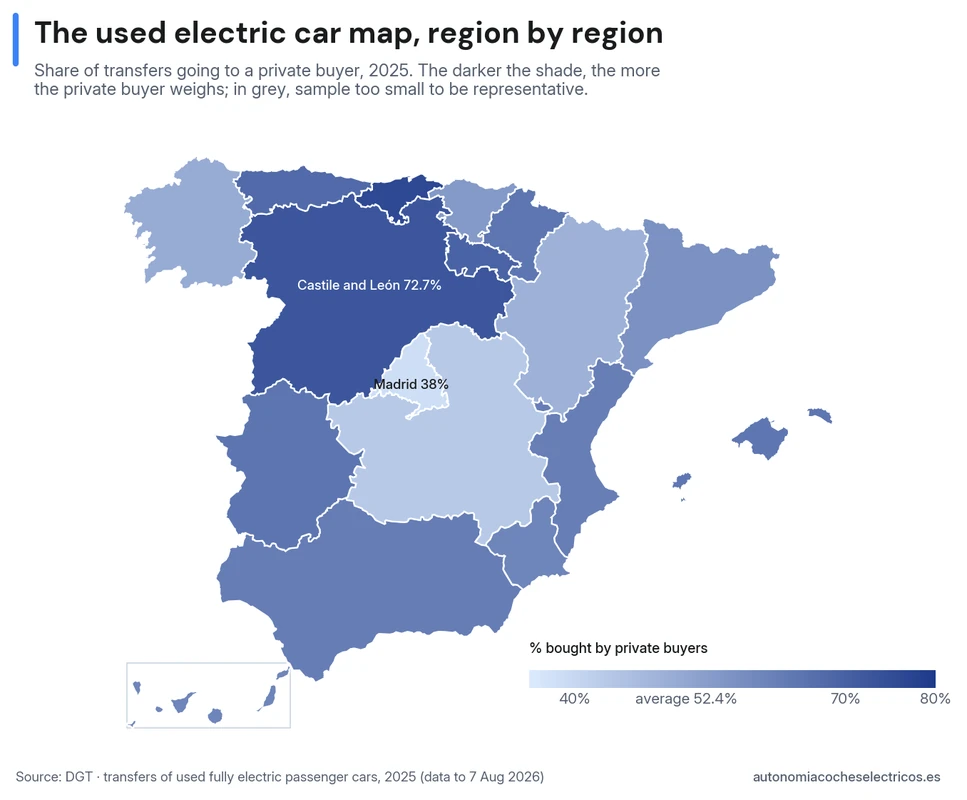
How to read this map
In a region, many used cars can change hands and be mostly bought by companies: leasing operators, dealerships, and other businesses account for a significant portion of transfers. That's why we order the map by the percentage going to private buyers, not by the number of transactions. The DGT distinguishes whether the recipient of the car is an individual or a legal entity, and this percentage measures how much of each market is private and how much is corporate.
The age of the car doesn't help distinguish regions: a used electric car changes hands at an average age of 2.9 years across Spain, from 2.3 in Galicia to 3.3 in Cantabria. These cars are equally young everywhere; what changes between regions is who buys them.
The map by regions
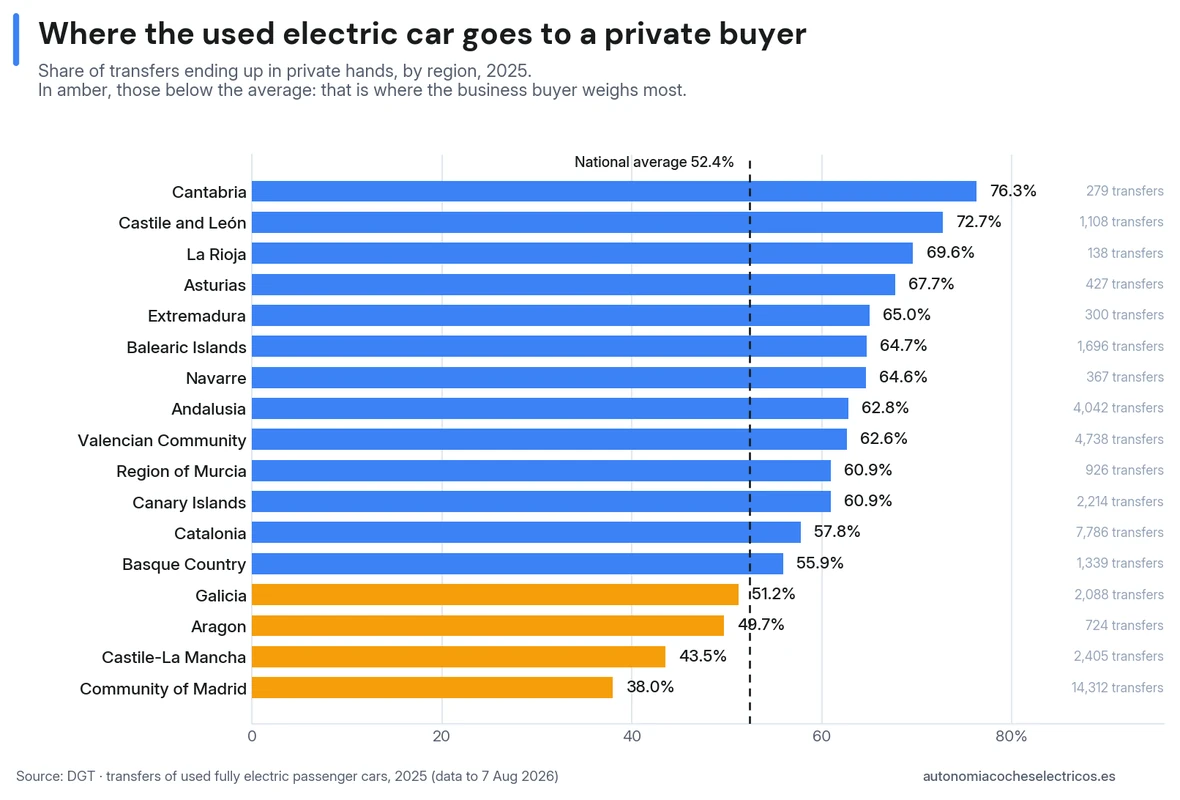
Ordered by percentage of private purchases, the regions are divided into three groups. At the top, small markets in volume but heavily focused on private buyers: Cantabria (76.3%), Castilla y León (72.7%), La Rioja (69.6%), Asturias (67.7%). In the middle, the large regions of the Mediterranean arc and the south, with a high private share and respectable volume: Comunidad Valenciana (62.6%), Andalucía (62.8%), Baleares (64.7%). And at the bottom, the two that pull the average towards the corporate side: Madrid (38%) and Castilla-La Mancha (43.5%).
Madrid is the best example of contrast. It transfers 14,312 used electric cars, almost double that of Cataluña and more than the ten smallest regions combined; yet, it is the region with the lowest share of private buyers: only 38%. Most of its transfers go to companies. Cataluña, second in volume, distributes more evenly (57.8%), and in Comunidad Valenciana or Andalucía, private buyers are already a clear majority.
The Toledo warning: when the province deceives
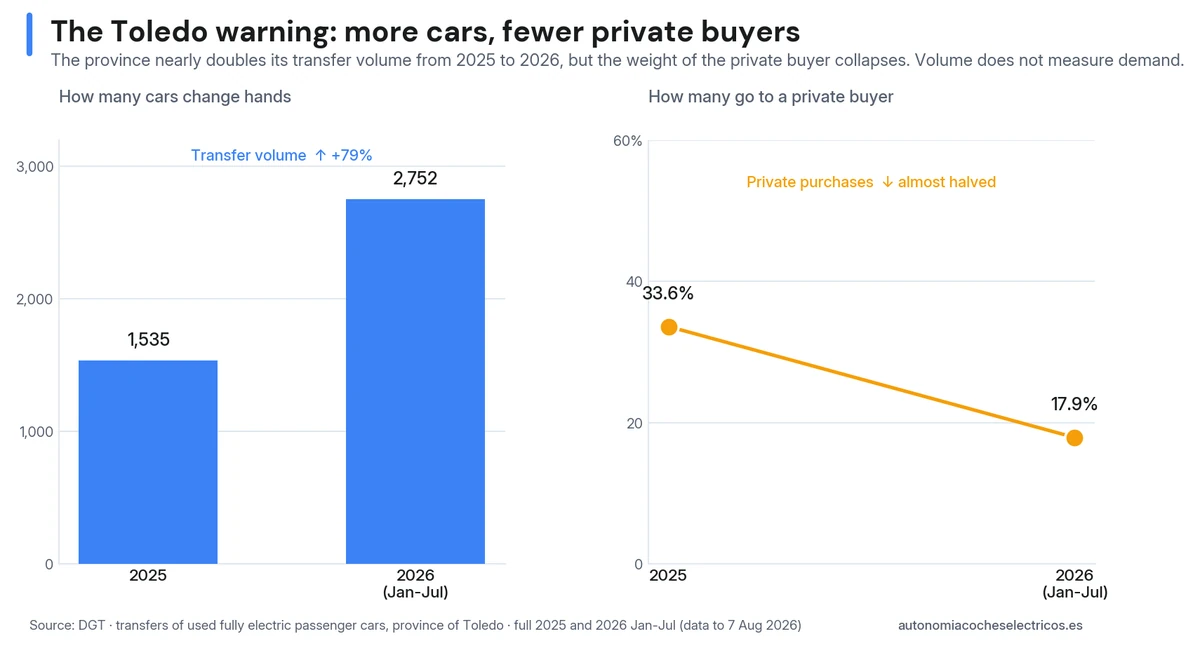
Toledo is the extreme case. In 2025, the province recorded 1,535 transfers of used electric cars, with only 33.6% going to private buyers. And in 2026, it skyrockets: between January and July, it accumulates 2,752, the third-highest figure in Spain — ahead of Valencia and Alicante — with just 17.9% going to private buyers. Eight out of ten used electric cars domiciled in Toledo are received by a company.
No one would say that more used electric cars are bought in Toledo than in Valencia or Alicante. What happens is that many companies domicile their cars there, even if they are used elsewhere. This weight drags down all of Castilla-La Mancha: Toledo concentrates 64% of the region's volume in 2025 and almost 79% so far in 2026, and that's why it lowers the region's private percentage to 43.5%.
It's the same trap we saw with new cars when separating the region from the province in Cataluña: the market is where someone buys the car to use it, not where a company registers it.
What is bought differently depending on the region
Each region also buys different models. The used electric market is the market of the previous generation: here, BYD, Leapmotor, and the latest Chinese wave dominating new registrations do not lead. The ten most transferred models of 2025 across Spain are, in order, the Tesla Model 3 (2,685), the Mercedes-Benz EQA (2,334), the Renault Zoe (1,821), the Mini Cooper (1,785), the Fiat 500e (1,267), the Nissan Leaf, the Tesla Model Y, the Smart Fortwo, the Dacia Spring, and the Renault Kangoo. It's the catalog of what was sold new two or three years ago, just what is now entering the used circuit.
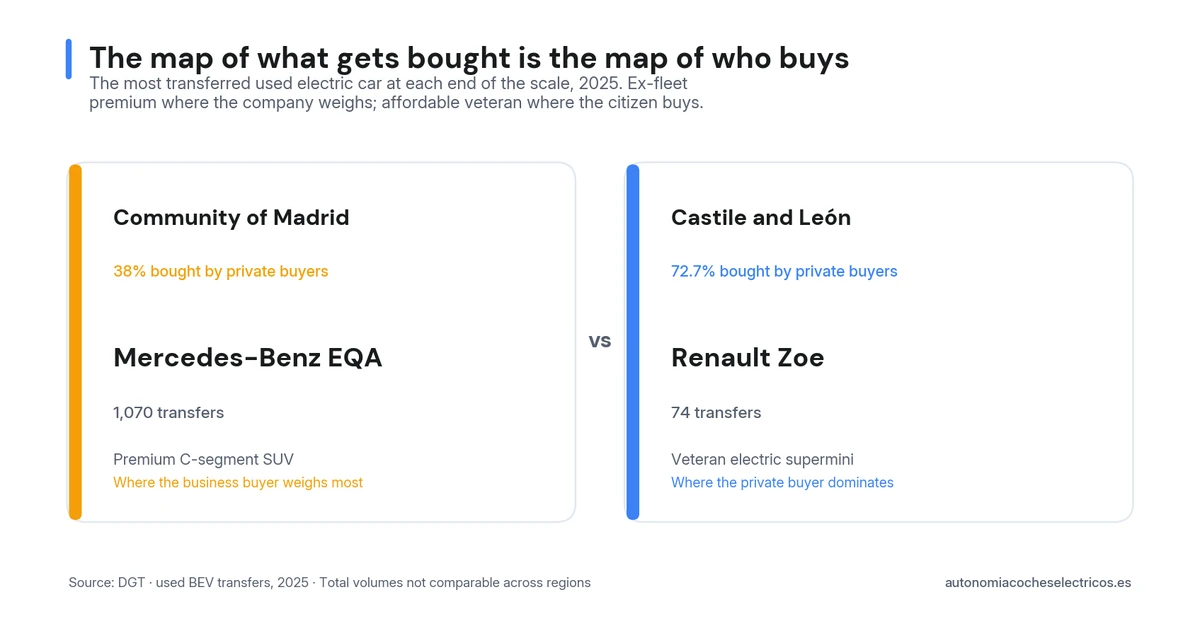
Against this common background, each region reveals its character. In Madrid, the most transferred used electric car of 2025 is the Mercedes-Benz EQA (1,070 units), a premium C-segment SUV, followed by the Mini Cooper and the Renault Zoe. In Castilla y León, however, the most transferred is the veteran Renault Zoe (74), with the Renault Kangoo and the Dacia Spring very present at the top.
The contrast repeats in the models: where companies dominate, the premium EQA is at the top; where private buyers lead, the veteran and affordable Zoe is. These are two different used car markets with different customers and, therefore, different cars. It's important not to go beyond what the data says: it's a pattern that fits, not proof that every EQA in Madrid was previously a company car. But the map of who buys and what is bought draws the same division.
The first seven months of 2026 maintain the pattern of 2025: the national private share holds at 53.8% from January to July, and the Toledo effect, far from correcting, grows. The next natural installment of this series is the buyer's profile — how much the used market discounts compared to new and which models hold their value better — and we will link to it from here as soon as it exists. Meanwhile, the most useful comparison remains the same map for new cars: Madrid and Andalucía also mark the two extremes when the car leaves the factory.
Methodology and data source
The data in this article comes from the official vehicle transfer database of the Dirección General de Tráfico (DGT), under the Ministry of the Interior of Spain.
The following filters have been applied to the raw data:
- Type of operation: transfer of ownership (used). First registrations of new vehicles are excluded.
- Type of propulsion: battery electric vehicle (BEV). Plug-in hybrids (PHEV), hybrids (HEV), and range-extended electric vehicles (REEV) are excluded.
- Identified model: only transfers where the vehicle is matched with a catalog model are counted. Operations without a recognized model are excluded from the count.
- Territorial scope: the region or province is determined by the domicile of the vehicle's acquirer, not where the operation is processed. At the provincial level, this domicile often coincides with the fiscal headquarters of a leasing company, the bias detailed in the Toledo section.
- Purchase channel: the percentage of private purchases is calculated on the same basis, counting transfers in the name of an individual versus a legal entity.
The figures correspond to transfers registered during the entire year of 2025, with data closed as of 7 August 2026. The 2026 data cited in the text covers from January to July, the latest closed period available.