


Every last working day of the month, electric car registrations in Spain multiply by three, four, and sometimes five times compared to a normal day. This surge is driven by the commercial calendar closing its accounts, not a wave of buyers: the bulk comes from companies, not private buyers, and many are cars registered to meet a target that reappear months later for sale as nearly new.
We've measured this using DGT registration data, day by day, from 2023 to June 2026. The pattern repeats every month and every year, with the same shape. Here we break it down: why it happens, who drives it, which models clearly point to self-registrations and which align better with fleet sales, and what all this means when you read a headline about "record sales" or when you're considering buying a nearly new electric car at a discount.
The monthly figures are accurate, but not all tell the same story. Learning to read them saves you surprises and, incidentally, opens up an interesting buying avenue.
The pattern: the calendar dictates more than demand
Plot the electric registrations of any given month and you'll see a curve, not a flat line. It starts slow in the first days, gradually rises, and spikes in the last week, with a sharp peak on the last working day. That last day alone accounts for between 11% and 17% of all registrations in the month.
In numbers: compared to the average of the first days —the normal pace, without the final ramp— the last day multiplies the volume of electrics by between three and six times. On 30 June 2026, 2,139 electrics were registered, when the average for a normal working day of the month was under 600.
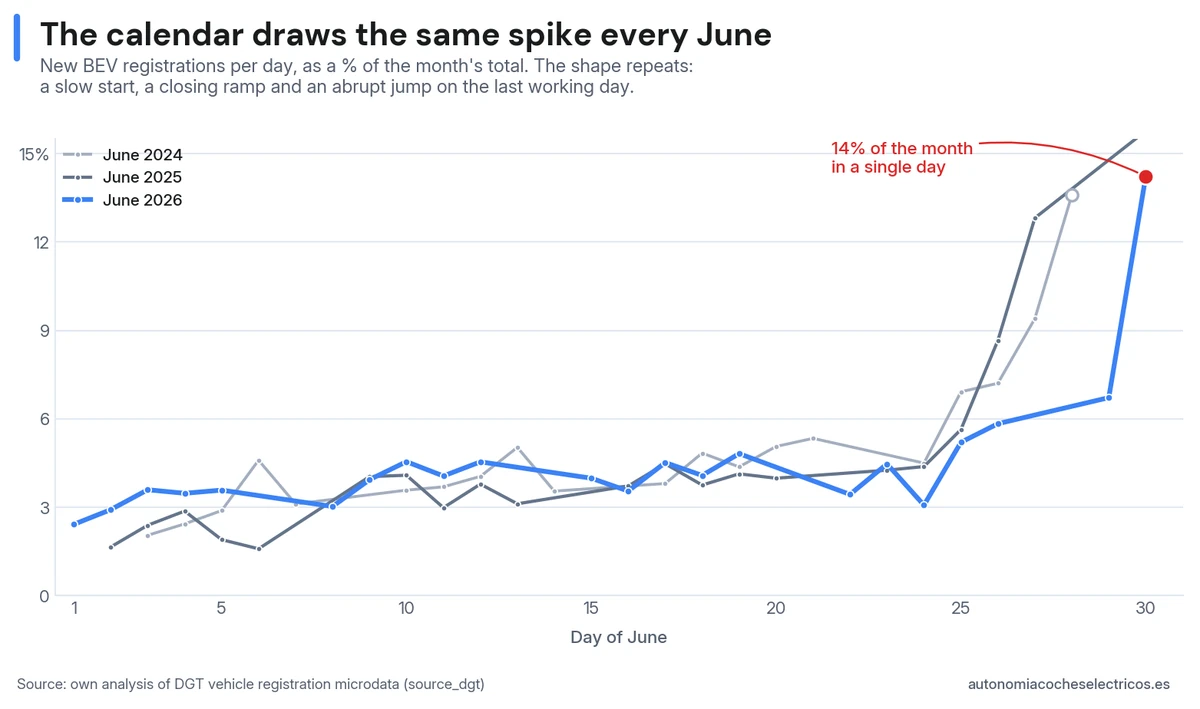
Side by side, June 2024, 2025, and 2026 draw the same silhouette: flat days until the last week and a vertical jump at the end. The volume changes —more electrics are registered each year— but the shape is identical.
And it happens always. In 2023, the last day multiplied the company channel by 4.4; in 2024, by 3.5; in 2025, by 4.8. It's not an anomaly of a specific month nor an effect of the 2026 incentives. It's a structural behavior, linked to how the sector counts its sales: by closed months. When the last natural day falls on a Saturday or holiday, the peak shifts to the last working day. The calendar rules.
Who registers on that day: the company channel, not you
The headlines don't tell one thing: that last day's peak is not driven by private buyers.
Separate registrations by type of owner and the pattern becomes clear. On a normal day, private buyers account for about 55% of electric registrations, companies 25%, and leasing the rest. But on the last day of the month, companies rise to 34%, and in some months up to 43%. In 2023, they became the absolute majority of the peak: more than half of the electrics registered on the last day were in a company's name.
The difference is clearer in the multiplier. On the last day, private buyers register about 2.6 times more than on a normal day, a moderate increase of people taking advantage of the month's end to sign. The company channel multiplies by 4.8 on average, and up to 8 in June 2026: a different magnitude. There, demand isn't concentrated; supply is placed. And it makes sense: a company can decide the exact day it registers a fleet to count it within the month, while private purchases are spread over the weeks, not depending on anyone's commercial calendar.
The DGT's own data refines the diagnosis further. Within the company channel, each registration carries a service code. One of those codes, for rental fleet, went from barely 60 registrations in all of June to 434 concentrated in a single day, the 30th. A rental company doesn't need 434 new cars all at once on a random Tuesday: those units are grouped through a fleet channel to ensure the record falls within the month.
What is a self-registration and why it exists
When a manufacturer or dealership has a sales target to meet —a market share to defend, a brand incentive to claim, a deadline not to miss— and lacks units to reach it, they have a resource: register cars in their own name or that of a related entity. That unit counts as "sold" for statistical purposes even if it doesn't yet have a final customer. This is what the sector calls self-registration.
The car is new and manufactured, just registered before having a buyer to be included in the month's figures. It is then parked at the dealership and sold with a license plate already on and a few kilometers: a km 0.
It's neither illegal nor hidden. It's a known and tolerated practice that helps smooth the commercial picture: achieving targets, maintaining a brand's share against rivals, or clearing stock. Everything points to a significant part of the company's last-day peak following this logic. We can't prove the commercial intent car by car —the DGT records the fact, not the motive— but the timing (always the close), the channel (company), and the subsequent destination (km 0) fit.
Which models point to self-registration and which to real fleet
Not all models behave the same, so it's worth looking at them individually. We cross-referenced two things: which models concentrate more volume in "company + last day," and which models reappear sooner in the used market as km 0. The resulting picture is not uniform.
The case whose pattern best fits tactical self-registration is Ford. Its Puma Gen-E, Explorer, and Torneo Custom appear high on both lists: they register heavily through the company channel right on the last day and are among the first to reappear for sale with few kilometers. The sequence "registered by company to close the month, resold as km 0" is fully compatible with what the data shows, even if we can't track each car individually.
The BYD Seal requires a second look. It has the highest percentage of all: one in three is registered through the company channel on the last day of the month. Yet, in km 0 resales, the Seal does not appear: those cars don't return to the used market within a few months. Everything points to fleets or real company deliveries that keep the car, consistent with BYD's accelerated growth in Spain. Same end-of-month company peak as Ford, different destination: Ford resells, here it stays.
The company's last-day peak is a measurable fact; whether it's self-registration depends on the model. In some cases, the pattern strongly suggests self-registrations. In others, it fits better with genuine fleet business. Mixing the two leads to misreading the figures.
What this means when you read "record sales"
Every beginning of the month, the headlines arrive: such brand leads, electric registrations break records, the market grows by a certain percentage. The figure is correct —those cars have been registered— but it sums two different things under the same number: cars a private buyer has decided to purchase and cars a company has registered to close their month.
Just look at the distribution to separate them. When a brand appears with a monthly figure far above its trend, it's worth asking how much goes to private buyers and how much to the company channel. Sustained growth in the private channel is real demand. A peak that appears and disappears within the same month, driven by companies, is account closing.
We take this into account when analyzing the Spanish electric market figures and when reviewing which models lead sales each month: the figures are the starting point, not the conclusion.
The practical consequence: why so many km 0 appear
This whole mechanism has a visible consequence in the market. Each month, hundreds of nearly new electrics enter the used market shortly after being registered: between 150 and 280 units less than three months old, according to DGT's own transfer data. Many come precisely from that end-of-month peak.
A km 0 is a car registered by the dealership or manufacturer, without a prior customer, with minimal kilometers —those from transport and some testing— sold as used. In practice, it's a new car with two differences: you're not the first owner on paper, and the price usually drops significantly compared to the MSRP, because the seller needs to move it.
Before jumping in, it's worth checking three things. The manufacturer's warranty starts from the date of that prior registration, not from when you take it, so check how long it's been registered. The equipment is what the dealership decided to register, not what you would have configured, and it might lack just the extra you're looking for. And confirm the battery's condition, which truly determines the value of a used electric car.
With those checks done, a km 0 is one of the most reasonable ways to enter the electric car market at a lower cost. If you're interested in this route, we explore it in detail in our guide on certified used electric cars.
The sector counts its sales by closed months, and that calendar draws the last day's peak. The same mechanism that inflates the statistics leaves, on the other side, nearly new cars waiting for a buyer with a license plate and discount already applied. Next time you see a "registration record," look at the channel distribution before drawing conclusions. And if you're looking for an electric, check out the km 0s that peak releases at the start of each month.