
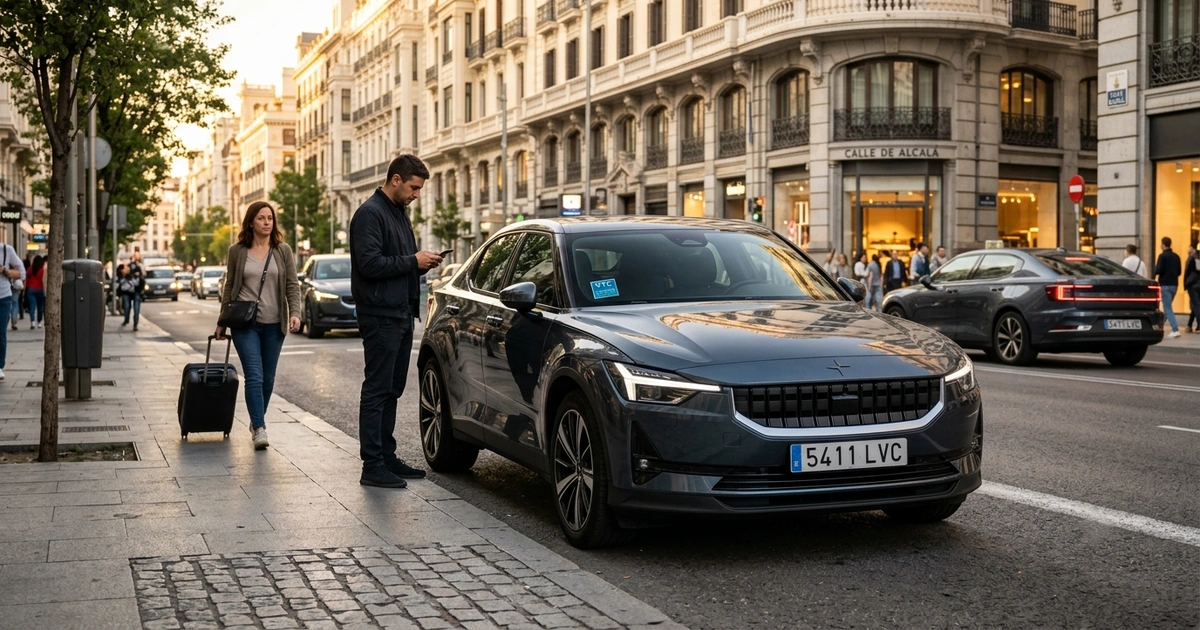

While private buyers continue to debate between hybrid and electric, the VTC has already made its decision. In 2025, nearly six out of ten new cars registered for hire with driver were 100% electric: a 58.9% share, more than four times the taxi's share and over six times that of the general market. The platform car —the one you order from the Uber, Cabify, or Bolt app— has switched to electric before anyone else and with more decisiveness.
The speed tells us even more than the figure. In 2024, the VTC was still hybrid territory, and pure electric didn't reach one in five registrations; a year later, the picture was reversed. Where other buyers consolidate their transition year by year, the VTC overturned its transition in a single year.
The explanation lies in how this market buys. The decision is made by a company renewing dozens or hundreds of cars at once, not a driver choosing their own: the vast majority of electric VTCs in 2025 were registered in the name of a company. When an operator of that size changes technology, the entire registry moves with it.
A clarification on what we've looked at. We analyzed the registrations of new cars with hire with driver service, according to the DGT registry: the cars operating under VTC license. Vans, used vehicles, and rent-a-car type rentals, which is a different service, are excluded.
A market that moves with licenses and orders
The VTC is unlike any other buyer. Its annual volume follows the BOE and fleet orders, not family economics or gasoline prices.
The series tells the story on its own. The channel grew very quickly until its peak in 2018, during the expansion of licenses and with the dispute with taxis at its hottest point; the Royal Decree-law 13/2018, which returned the key to urban service to communities and municipalities, and then the pandemic, slowed it down for several years. The recovery eventually led the channel to a new high in 2025, with 6,793 cars registered.
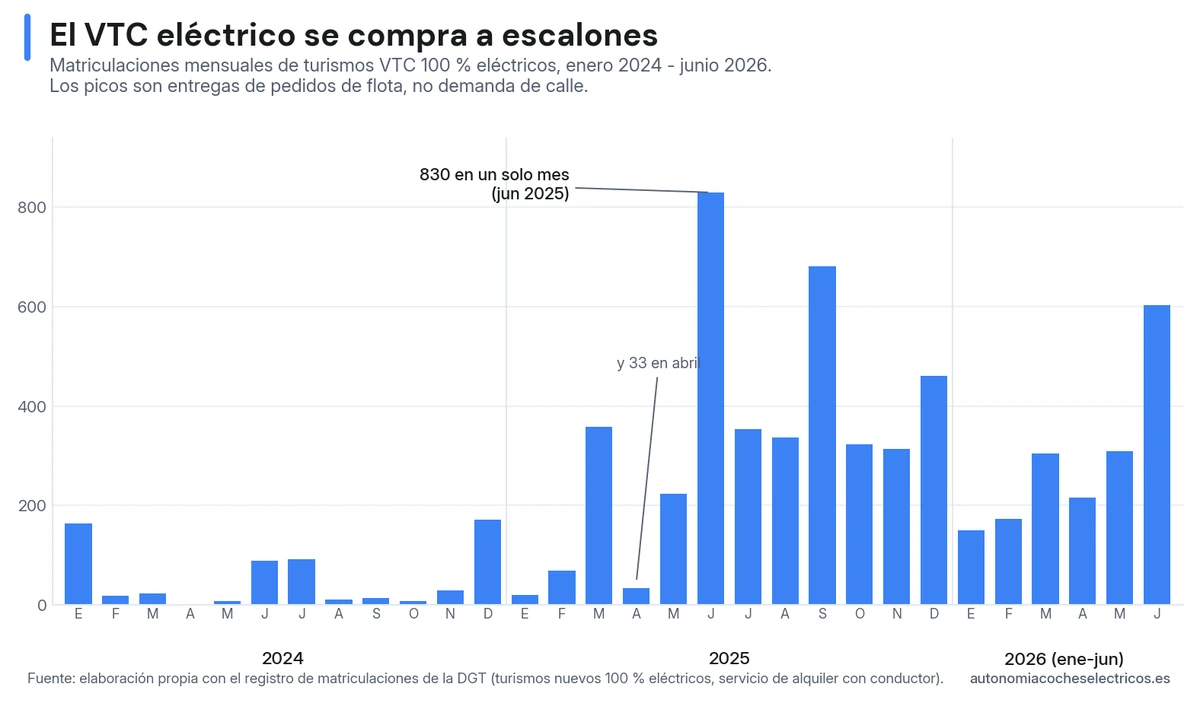
Within each year, the pattern repeats on a monthly scale. In June 2025, 830 electric VTCs were registered, almost triple what the channel had registered in electric during its first nine years; in April of that same year, there were 33. These peaks are deliveries of orders, not street demand. The VTC doesn't buy cars: it receives batches.
The shift: from hybrid to electric majority in a single year
With that groundwork clear, here's how the distribution by technology has changed over the total of new VTC cars registered each year.
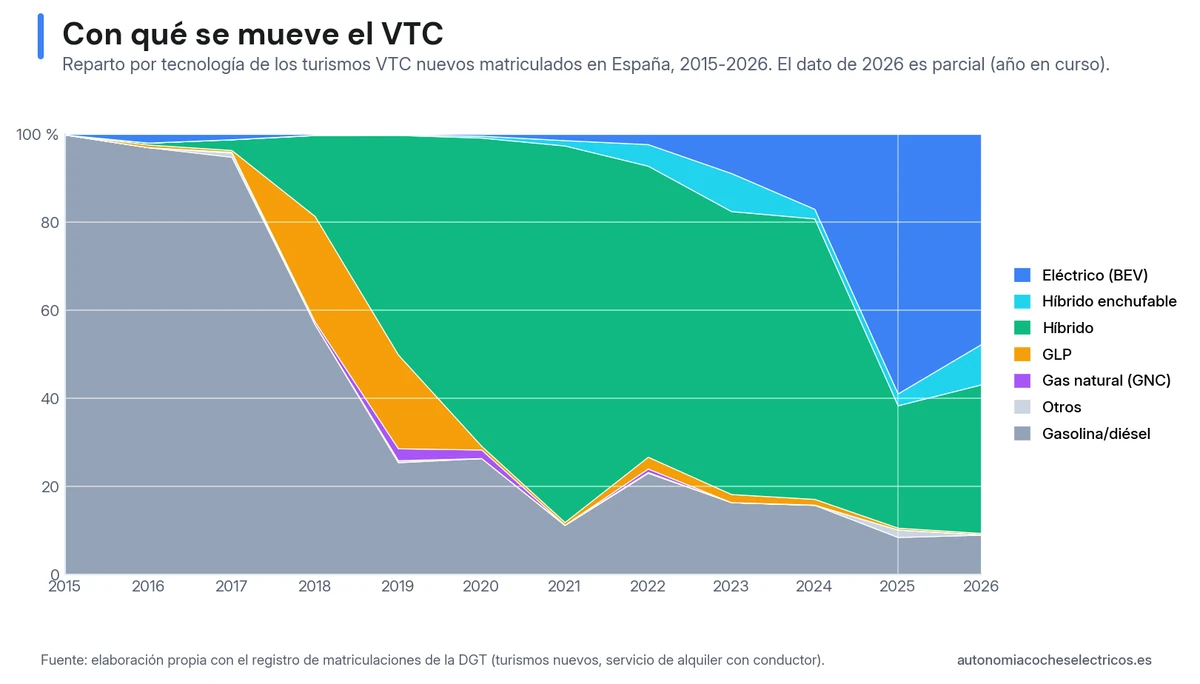
*2026, partial data for the current year.
The table condenses three eras. The first is the era of absolute diesel: in 2015, 99.9% of new VTCs were pure combustion, the classic diesel sedan. The second begins with the 2018 boom and has an unexpected protagonist: LPG. Almost one in four VTCs in 2018 was registered in autogas —905 units, more than a hundred times the electric vehicles of that year— because operators of the boom needed the ECO label and a cheap fuel without changing habits. From LPG, the channel jumped to hybrid, which accounted for 85.5% of registrations in 2021 and dominated until 2024.
The third era begins in 2025 and is a shift, not an evolution. Pure electric went from 17% to 58.9% in one year, hybrid fell from 63.7% to 27.8%, and pure combustion dropped to 8.5%. Adding plug-in hybrids, 61.6% of VTCs registered in 2025 plug into the grid. At the start of 2026, electric remains the leading technology in the channel, with 47.7%, although below the peak of the previous year; plug-in hybrids, on the other hand, rise to 9.1%, their historical maximum.
This shift is unprecedented in the records we've analyzed. The taxi took a decade to bring electric from 0% to 15% and remains a hybrid channel. The VTC made a greater journey in twelve months.
Why a fleet chooses electric
The underlying arithmetic is the same that electrifies taxis, but multiplied. An urban VTC accumulates many kilometers per year, and at those mileages, electricity costs about a third of diesel per kilometer, with maintenance between 40% and 60% cheaper. For a private individual, that saving is an argument; for an operator with hundreds of cars, it's the bottom line.
Cities add to the equation. The VTC lives off urban centers, precisely where low-emission zones tighten, and the ZERO label buys access and regulatory peace of mind for the car's useful life. That's why Madrid, with the largest VTC fleet in the country, concentrates four out of ten electric registrations in the channel in 2025 and almost half so far in 2026.
And there are corporate decisions, which in this sector leave a verifiable trace. Uber has set 2030 as the date to operate only with zero-emission vehicles in Europe and signed an alliance with BYD in 2024 to incorporate 100,000 electric vehicles into its platform, starting in Europe; Cabify obtained financing from the European Investment Bank to deploy 1,400 electric vehicles in Spain. These are not gestures. They are economic decisions: corporate clients demand low-emission vehicles, and cities tighten restrictions. And the DGT registry confirms that the cars exist: the announced orders appear in the registrations with the model's name and surname.
The VTC car: from the Model S of 2016 to the era of the BYD Seal
The first 100% electric VTC in the registry was registered in Madrid in July 2015, and it was a BYD e6, a Chinese taxi-sedan that almost no one remembers. Ten years later, that brand dominates the channel. In between, the electric VTC car has changed its face three times.
The first stage was luxury: in 2016 and 2017, practically all electric VTCs were Tesla Model S, 22 and 25 units per year destined for high-end chauffeur service. This was followed by a five-year desert crossing —between 2018 and 2022, the channel never exceeded 26 annual registrations— and a takeoff with a familiar flavor: in 2023, the Tesla Model 3 accounted for 120 of the 178 electric VTCs of the year, the same pioneering role it had already played in taxis. 2024 was the year of distributed orders, with three almost tied models competing for the same contracts: Model 3 (170), Kia Niro Electric (160), and Polestar 2 (158).
And in 2025, the BYD wave arrived. The Seal accounted for 1,429 registrations, more than a third of all electric VTCs of the year, and the entire brand reached 43% of the channel. In the first half of 2026, the concentration is increasing: these are the most registered electric VTCs of the year.
The list portrays the buyer. The Seal is the budget sedan from the Uber and BYD agreement; the Kia EV4 has appeared out of nowhere to the third spot in a matter of months, the typical move of a large order; and the bZ4X, the king of electric taxis, also works here. That three of the top eight are Chinese brands —BYD, Deepal, and Leapmotor— says a lot about how this market buys: price and cost per kilometer weigh more than the traditional brand.
What the first half of 2026 says
In the first half of 2026, 1,756 electric VTCs were registered, a 14.7% increase over the same period in 2025: the level of the year of the shift consolidates instead of deflating. The correct comparison is that, semester against semester, because the annual registry compares half a year against a whole year and appears to show a drop of more than 50% that disappears when comparing at the same date.
The context puts it in place: in those same six months, the general electric market grew by 36%. The VTC, which in 2025 accounted for almost four out of every hundred new electric vehicles in the country, drops to 2.7% in the semester. After the 2025 binge, the channel no longer drives the market: it normalizes. With a warning: in a market that advances with contract blows, a single order in autumn can twist all the curves again. We will update the series at the end of each year.
A different laboratory
The taxi shows us if the electric vehicle convinces a professional who risks their own money. The VTC shows something else: if the electric vehicle wins an account made with cold calculation, without attachment to brands or habits, where only cost per kilometer, the label, and the contract matter. In 2025, it won by an absolute majority.
The private buyer is still deciding if the electric car is worth it. The VTC has already done that calculation. And when an industry that lives off cost per kilometer changes technology en masse, the signal goes far beyond its own sector.
DGT Registrations
The key figures of the electric car in Spain, with the summary of the month and the current year.
02By Usage
The new electric car in Spain by usage: private, company, leasing, rental, and taxi, with the ranking of brands and models for each.
03Leasing
How many new electric cars are registered for rent-a-car in Spain, and which brands and models are chosen.
04VTC
How many new electric cars are registered for hire with driver in Spain, and which brands and models are chosen.