
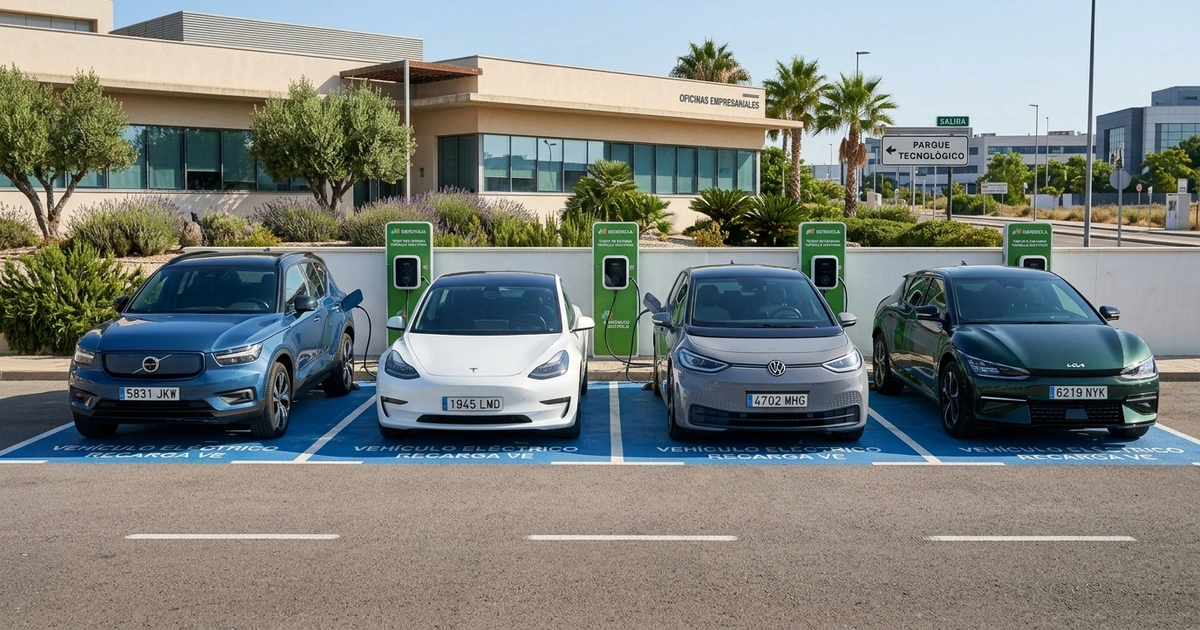

In 2016, more than eight out of ten new electric cars registered in Spain had a company's name on the registration. The private buyer was barely present. For almost a decade, it was fleets, dealerships, and service companies that sustained the Spanish electric market.
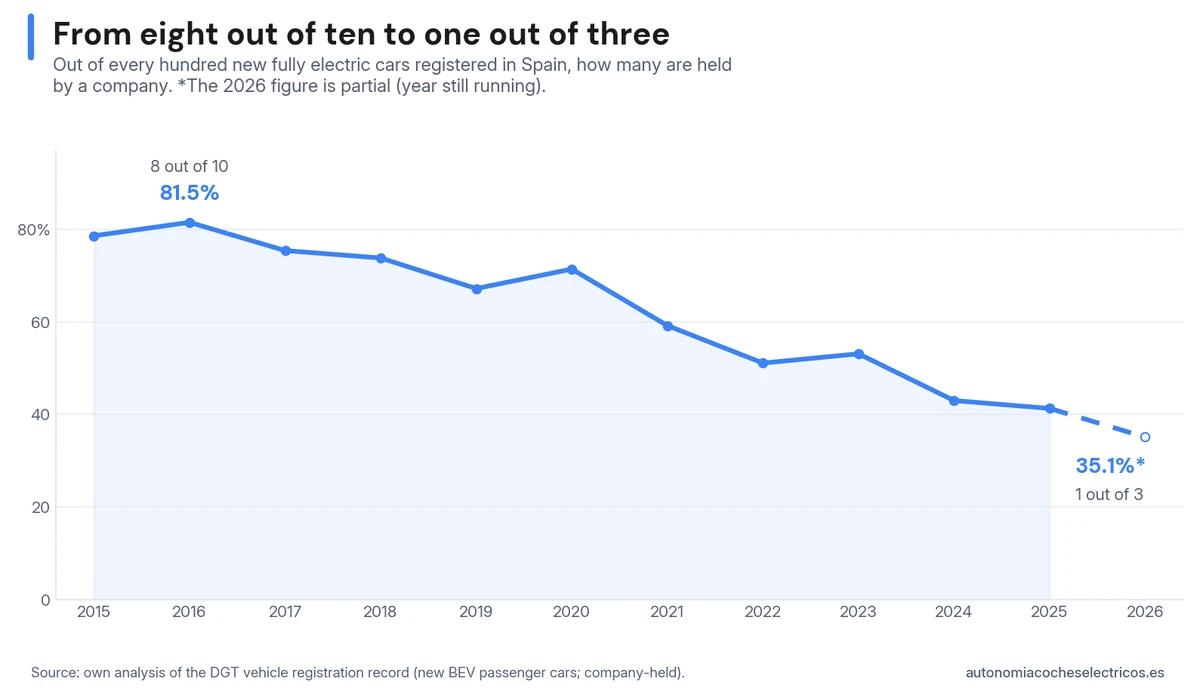
Ten years later, that picture has reversed. Companies are registering more electric vehicles than ever —42,958 in 2025, forty-seven times more than in 2015—, but their share has fallen from 81% to 35% of all electric vehicles registered in Spain: today they account for just over one in three. And in the first half of 2026, the gap widened suddenly, because while companies barely grew by 3%, the electric market advanced by 36% and private purchases soared by 66%. The electric vehicle no longer needs companies to push it: people are buying it.
A clarification on what we've examined. We analyzed the registrations of new 100% electric passenger cars registered in the name of a company —a legal entity— versus those registered in the name of an individual, according to the DGT registry. Vans and used cars are excluded.
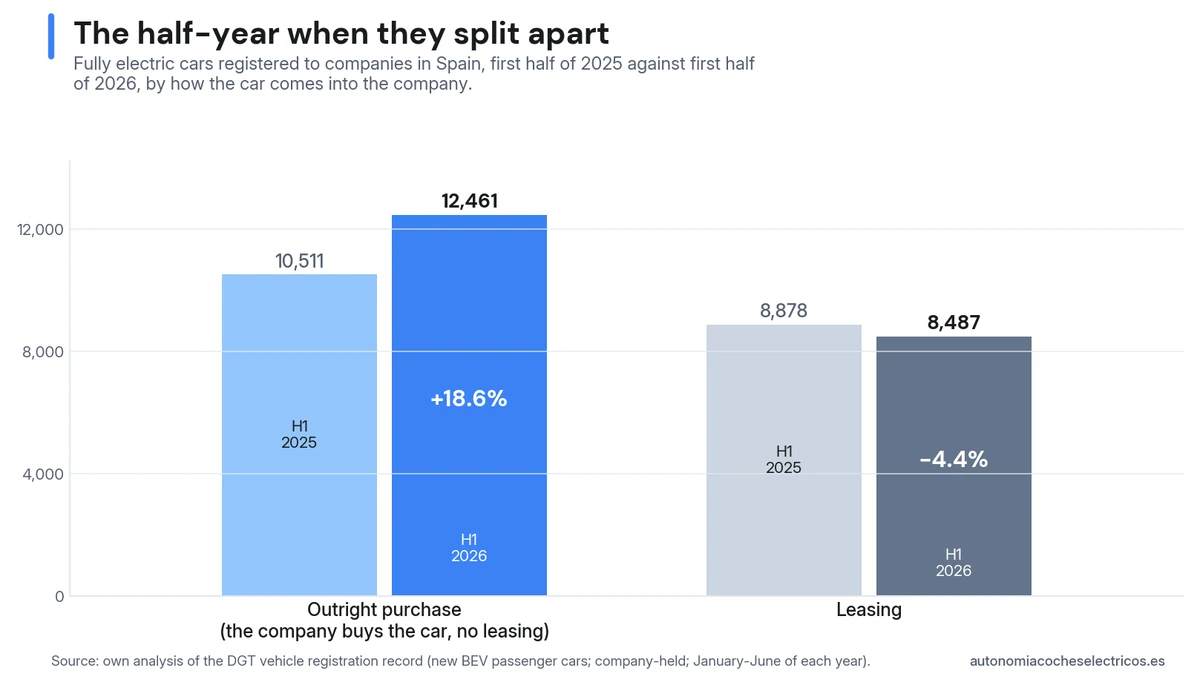
Within these figures, there's a finding we didn't expect. It's not leasing that's growing, which fell by 4.4%, but rather the companies that buy the car and register it in their name for use: an 18.6% increase in the first half of 2026.
From 912 to 43,000: the decade when companies took the wheel
In 2015, 912 pure electric vehicles were registered in the name of companies, and almost half —421— were rental cars without a driver. That year, carsharing arrived in Madrid with fleets of electric Smarts, and it's hard not to link that arrival with Smart being the leading brand in the channel with 374 units. The first "company" electric car in Spain didn't sleep in an office garage: it was parked on the street, waiting for someone to rent it by the minute.
From there, the curve rises almost without pause: 1,655 in 2016, 4,570 in 2018, 6,964 in 2019. In 2020, the first big leap occurred, and it's striking given the context: in the midst of a pandemic year, with the passenger car market down by a third, companies almost doubled their electric registrations to 12,969. The European regulation requiring manufacturers to cut average emissions of what was sold came into force precisely that year, and much of that push was likely generated by the manufacturers themselves and their networks, who needed to get electric vehicles on the road.
The rest of the series maintains its course with only one dip: 16,070 in 2022, 29,127 in 2023, a decline to 25,314 in 2024 —the only year the channel fell while the electric market grew— and the record of 42,958 in 2025, a 70% increase over the previous year.
From eight out of ten to one out of three
The other half of the story is what portion of all electric cars registered in Spain have a company as the owner. In 2016, 81 out of every hundred. In 2019, 67. In 2022, 51. In 2025, 41, and in the first half of 2026, 35 out of every hundred. The share of companies in electric cars has fallen almost continuously over a decade.
The contrast is also seen by looking at what each buys. Of every hundred cars that companies registered in 2025, seven were pure electric; of every hundred registered by private individuals, eleven. So far in 2026, the gap has widened: the electric share of the private buyer is now about double that of the company channel.
Companies haven't abandoned electric vehicles. They register more than ever and are growing, albeit slowly. What has changed is the rest of the market: the average buyer —who for a decade watched as fleets tested the technology— has started buying en masse. That the Spanish electric vehicle increasingly depends less on fleets is the best sign of maturity this market can give.
Companies buying cars grow; leasing declines
A company acquires an electric vehicle through two main routes: it buys it outright and registers it in its name, or it leases it long-term through leasing. Since the owner of a leased car is the leasing company —also a company—, those registrations count within these figures. In 2025, outright purchases accounted for 20,604 registrations, almost half of the channel; leasing contributed 17,174, four out of ten; the rest was divided between rental companies and VTC fleets.
The two routes are moving at opposite paces. In the first half of 2026, outright purchases grew by 18.6%, from 10,511 to 12,461 units, while leasing fell by 4.4%. The explanation lies in resale value: the leasing company recoups its investment by reselling the car at the end of the contract, and uncertainty about what a used electric vehicle will be worth makes it hesitant. The company that buys the car to keep it doesn't depend on that resale, and it's the one driving the channel.
How company cars are powered: the technology breakdown
Electric vehicles compete within the channel with all other technologies, and the story is the same as we saw in taxis and leasing: the one that has retired the company diesel is not the plug, but the hybrid. The table shows the share of each technology over the total new passenger cars registered by companies each year.
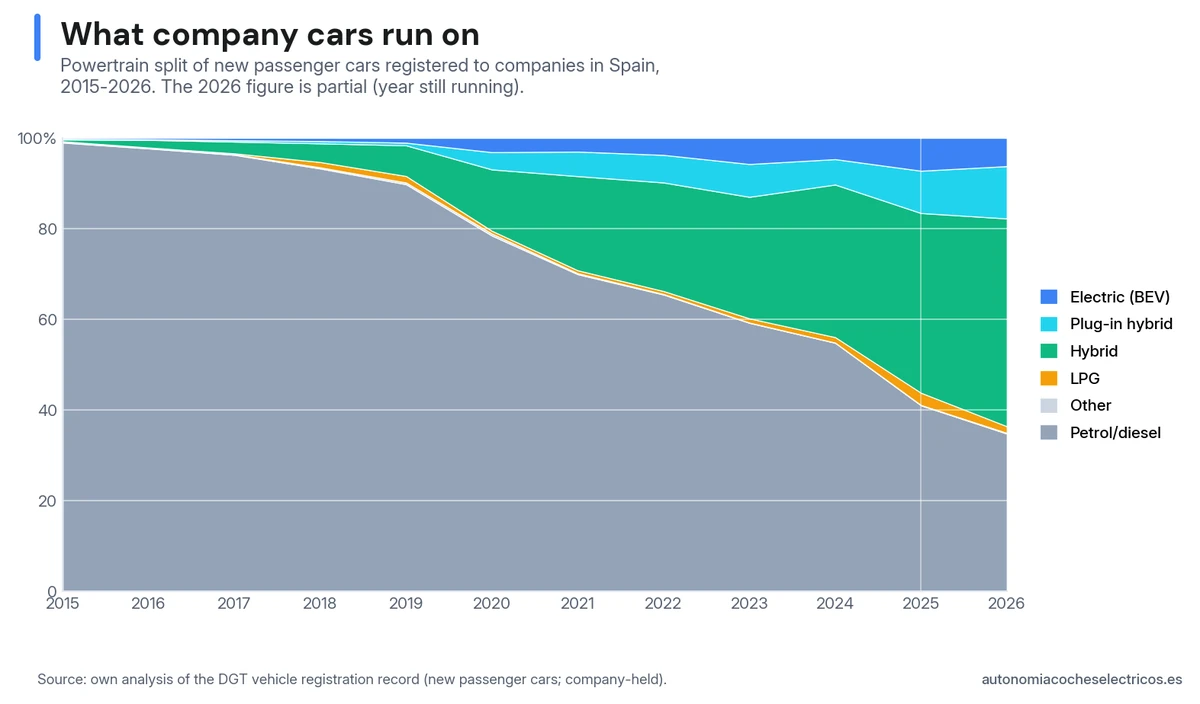
*2026, partial data for the current year.
Gasoline and diesel have gone from accounting for 99% of company cars in 2015 to just over a third in 2026. That gap has been filled mainly by hybrids, which now account for nearly half of the channel, with plug-in hybrids above 11%.
Pure electric vehicles, with their 7.2% in 2025, fall below the overall market (9%) and clearly behind the private buyer (11%). If we add up everything that plugs in —pure electric and plug-in hybrids—, the company channel reached 16.5% in 2025 and is nearing 18% in 2026. The transition of the company fleet is advancing, but with the plug as support rather than a complete substitute for the tank.
From carsharing Smarts to the BYD Seal: brand transitions
The brand that sells the most electric vehicles to companies has changed six times in a decade, and each transition depicts a stage. Smart led in 2015 thanks to carsharing. Citroën and Renault dominated the following years with small urban fleet electrics, with Nissan interspersed in 2019. Between 2022 and 2024, the channel experienced its premium phase with Tesla at the forefront: the Model 3 and Model Y as company cars and in-kind compensation. And since 2025, BYD has led, with 4,013 registrations that year and the top spot also at the start of 2026.
BYD's leadership isn't due to a single buyer: more than half of its company registrations in the first half of 2026 are outright purchases, and a third are VTC fleets, where the Seal has become the sector's standard car. These are the most registered electric vehicles by companies in the first half of 2026:
The list mixes worlds that five years ago didn't intersect: the Chinese fleet sedan, the traditional German premium —Mercedes-Benz and BMW remain the second and third brands in the channel—, the affordable urban SUV, and the compact Korean. The company of 2026 no longer buys just one type of electric vehicle, and that variety, more than any figure, describes a channel that has ceased to be an experiment.
Tax incentives help, but don't decide
Tax incentives help, but the data indicates they don't solely explain the electrification of companies. On paper, it's rarely been as attractive to buy an electric vehicle in the name of a company. Since 2024, investments in pure electrics related to the activity can benefit from accelerated depreciation: the company can deduct the entire cost of the car in the first year, instead of spreading it over a decade, as noted by the Tax Agency. And when the car is also provided to an employee for private use, the valuation of that in-kind compensation is reduced by 30% if the car is a battery electric, which lowers its tax bill compared to the same car with a combustion engine.
In addition to tax incentives, there are direct purchase aids. The MOVES III plan included companies among its beneficiaries until it ran out at the end of 2025, and the Auto+ Program of 2026 maintains them: up to ten vehicles with aid per company and, for smaller ones, an amount per electric passenger car higher than that for private buyers —6,000 versus 4,500 euros— according to the Ministry of Industry.
Outright purchases jumped 73% in 2023, the year the first depreciation incentive was introduced, but that was also a record year for the entire electric market, so it's impossible to attribute the credit to a single cause. And the entire channel is growing today at 3% with the most generous fiscal package it has ever had. The conclusion is uncomfortable for any brochure: incentives grease the decision of the company that already wanted to electrify, but they don't move the one that wasn't sure. There, the total cost of use, charging, and resale value still weigh more.
The channel that has already fulfilled its role
For a decade, companies were the bridge for the Spanish electric car: they sustained registrations when there were no buyers, absorbed the first models, and put on the road the cars with which many drivers first tested the technology, whether in carsharing, an airport taxi, or a colleague's company car.
That role is now fulfilled. Companies have never registered as many electric vehicles as they do now, and yet they've never weighed so little within the Spanish electric market. The growth of the electric car increasingly depends on the private buyer, and that transition explains better than any other figure how the electric car has matured in Spain. We will update this series as the years close, because the day companies electrify faster than the private buyer again —with leasing buying electric without fear of resale value— will be the signal that the transition is nearly complete.