
In the late nineties and throughout the 2000s, the Spanish taxi had an almost default car: the Škoda Octavia. Just looking at the street, you could see it, and behind it was a simple calculation that any taxi driver knew how to make. The Octavia shared its platform and engines with the Audi A3 and the VW Golf —including the legendary 1.9 TDI, capable of nearing a million kilometers— but was sold at the entry-level price of the group, like a SEAT. Almost Audi engineering, reliability that surveys placed even above Volkswagen itself, and the lowest bill among all the sister brands. For a taxi driver, there was no debate.
That same calculation —profitability above all— is what's electrifying the taxi today. With an important precision: the taxi driver has mostly switched to hybrids, and pure electric vehicles are still a minority, although they are the fastest-growing technology. These figures are about them.
A clarification on what we've looked at. We analyze the registrations of passenger taxis, that is, cars. Vans and large minivans approved for autotaxi are excluded, as they play in another league and deserve their own analysis. Everything that follows are passenger cars registered as taxis, according to the DGT registry.
With that focus, the growth of pure electric vehicles is remarkable. In 2015, seven 100% electric taxis were registered in all of Spain, barely 0.1% of the new taxis that year. By 2025, there were 1,083, one in seven registered taxis (14%). Along the way, leadership changed hands twice: first Nissan with the Leaf, then Tesla for four years, and since 2025, the Toyota bZ4X.
In the first half of 2026, the pace continues. Electric taxis account for 604 registrations —15% of new taxis— compared to 478 in the same period of 2025: a 26% increase. Compared to the entire previous year, it might seem to fall, but it's a calendar mirage, because half a year is not measured against a whole year.
From seven to over a thousand: ten years of growth
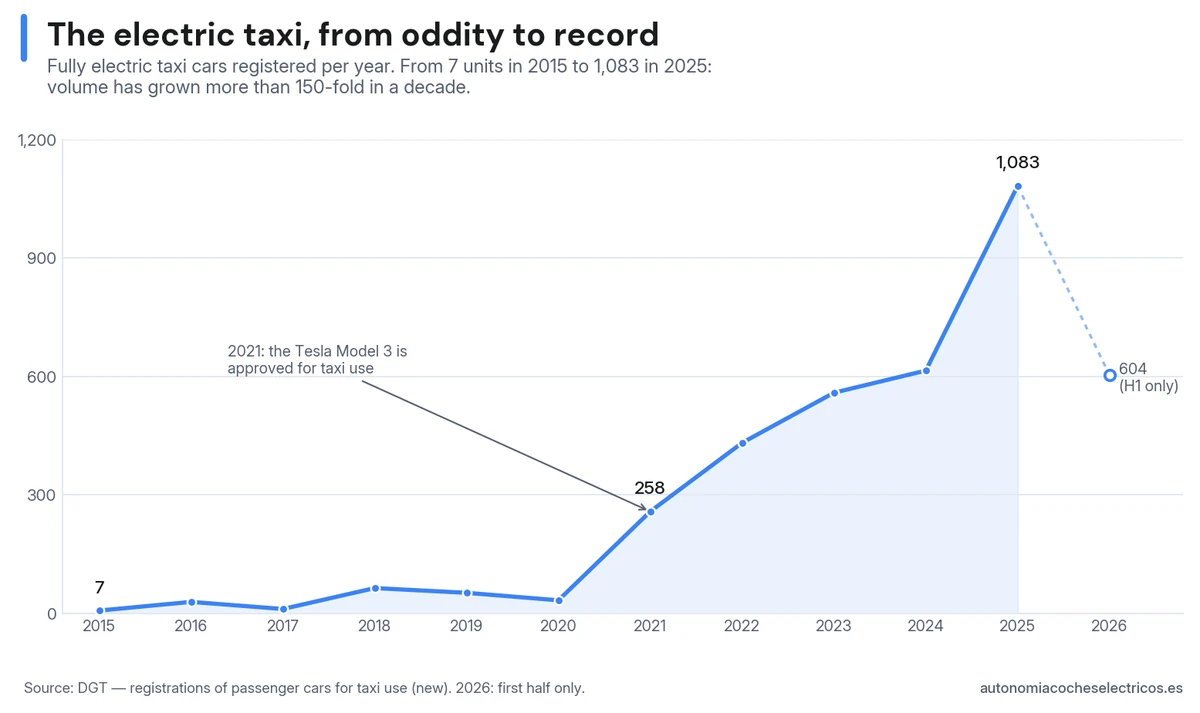
During the second half of the last decade, the electric taxi barely existed: 7 units in 2015, 29 in 2016, 11 in 2017, 64 in 2018. Numbers so small that a single fleet order could shift the ranking from one year to the next. The electric taxi driver's car was almost always a Nissan Leaf, with the e-NV200 for those needing more space.
The turning point came in 2021, and there's an explanation. The Tesla Model 3 had just been approved as a taxi in Madrid and Barcelona, and it was the first electric vehicle with enough range and charging network to withstand a full day without surprises. At the same time, major cities began requiring ECO or ZERO labels for new taxis, closing the door on diesel. Together, these factors boosted registrations: from 33 to 258 in one year. From there, a steady rise: 432 in 2022, 559 in 2023, 615 in 2024, and 1,083 in 2025, almost double the previous year. In a decade, the annual figure has multiplied by more than 150, reaching one in seven new taxis.
The journey had bumps. There were years of decline —2017, 2019, 2020— but with so few units at play that just a few dozen fewer cars could skew the data from one year to the next. The underlying trend didn't change: the electric taxi stopped being a rarity and became a common purchase in the sector.
The leadership shift: from Nissan to Tesla and Tesla to Toyota
The story of the electric passenger taxi can be well explained through which model dominated each year, as leadership has changed hands twice, and each shift tells a different stage.
The Nissan stage (2015-2020). When few units were sold annually, the Leaf was the reference car: in 2018, its best year of this phase, it accounted for 43 of the 64 registered electric taxis. It was the affordable electric vehicle of the time, and the taxi driver who ventured into it relied on what was available in the market.
The Tesla stage (2021-2024). The leap in 2021 has a name: Tesla Model 3. Largely because there wasn't much else to choose from: it was one of the few electric vehicles with enough range and its own charging network —the Supercharger— capable of covering a taxi day without surprises. The underlying appeal was economic, and the numbers are solid: a car that covers many kilometers saves a lot by switching from burning diesel to using electricity, with a cost per kilometer around a third of that of a diesel and maintenance bills between 40% and 60% lower.
The decision wasn't as straightforward as often portrayed. The reliability of the Model 3 in those years wasn't proven: independent reliability studies placed it below the average for its category, with complaints about finish quality and a long list of recalls. The brand also didn't have a workshop network designed for taxis or a tradition in the sector. Those who ventured early were pioneers, financially capable of risking 50,000 euros and with enough kilometers to make it worthwhile. They weren't the average taxi driver; they were the vanguard.
Even so, Tesla went from a single taxi in 2020 to 124 in 2021 and led for four years. In 2023, the Model Y took over from the Model 3, and in 2024 the brand registered 441 taxis almost equally between the two (222 Model 3 and 219 Model Y).
The Toyota stage (2025 onwards). In 2025, leadership changed hands again, and the reason says a lot about what taxi drivers look for when the market offers choices. The Toyota bZ4X, almost absent until 2024, jumped to 555 units and became the best-selling electric taxi in a single year. It didn't win on price, as it's not the cheapest electric vehicle. It won by offering what Tesla didn't: Toyota's proven reliability, a workshop network in every city, and a warranty designed for those who live off their car, with specific battery coverage for ten years. Toyota has been the taxi brand since the hybrid Prius, and that backing weighs more than any novelty.
The same pattern explains the rise of the Škoda Enyaq, a European brand with service and warranty behind it. When electric vehicles as capable as Tesla's appeared but with the network and support of a traditional manufacturer, the rational taxi driver —who views the car as a work tool— moved towards them. The taxi fleet of any Spanish city confirms it: dominated by reliable brands with nearby service, not by the trendy car.
What the first half of 2026 says
In the first half of 2026, the bZ4X remains at the forefront, but the interesting part is behind it. These are the most registered electric taxis so far this year:
The list has expanded. In 2024, the electric taxi podium was mostly Tesla. Now the Škoda Enyaq sneaks into second place, ahead of the two Teslas, and there's a historical nod in that: Škoda, the diesel taxi brand from twenty years ago, returns to the top of the list with an electric SUV. Behind are models that weren't even on the radar two years ago, like the KG Mobility Torres EVX, the XPENG G6, or the Škoda Elroq. The taxi driver of 2026 has much more to choose from than in 2021, when almost everything registered was a Tesla Model 3.
How much the taxi weighs within the electric car market
The taxi is a small niche in the electric market. The 604 taxis in the first half of 2026 represent 0.9% of all new electric passenger cars registered in Spain during the period: out of every hundred electric vehicles hitting the streets, less than one carries a taxi plate. The bulk consists of cars for private buyers, companies, and leasing.
This reduced weight doesn't diminish the interest in the data, for one reason: the taxi is a demanding testing ground. A taxi driver covers in a year the kilometers that a private owner takes five years to accumulate, charges daily, and needs the numbers to add up. That more than a thousand professionals choose an electric vehicle each year says something about the maturity of the technology that figures for private buyers, more influenced by incentives and trends, don't capture as well.
What drives the taxi: the distribution by technologies
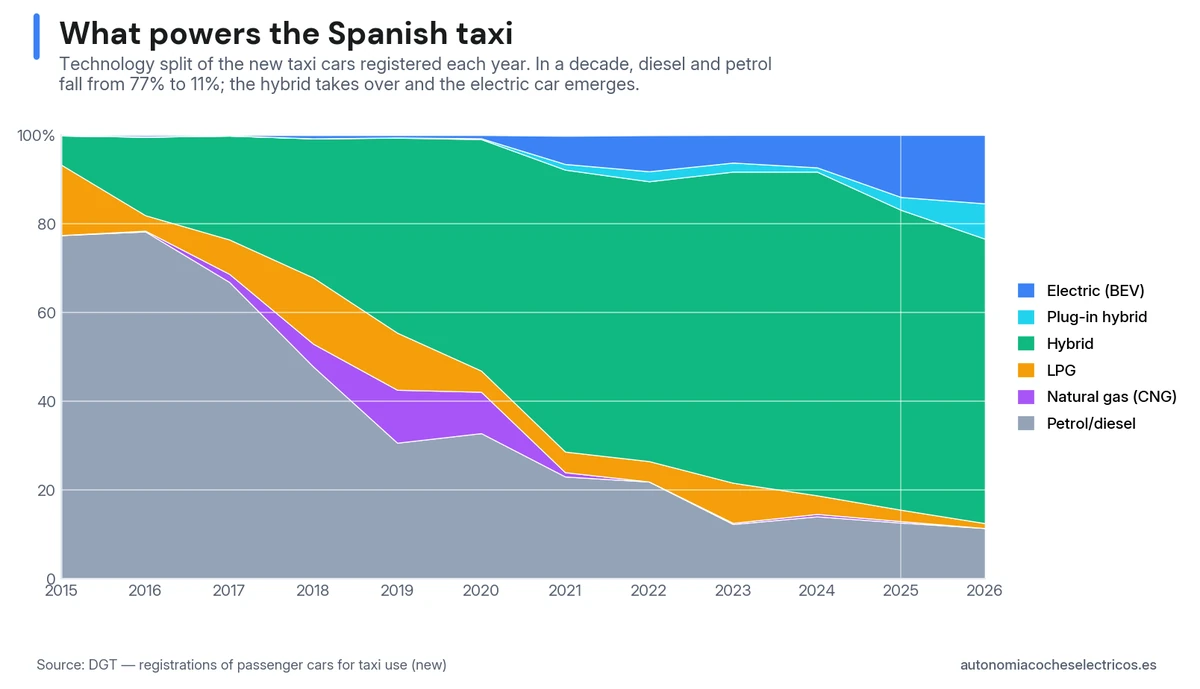
The battery electric vehicle doesn't compete alone. Within the total of new taxis registered, across all energy types, its share has risen from nothing to 15% in eleven years: it was 0% in 2015, 1% in 2020, and 14% in 2025. One in seven taxis debuting in 2026 is 100% electric. The following table shows how the weight of each technology has changed over the total of new taxis.
The major driver of change in taxis has been the hybrid. Of the 7,752 new taxis in 2025, 5,238 carried a hybrid label (68%): the Toyota Corolla and the ever-present Prius are the foundation of the Spanish taxi. For taxi drivers, it was the natural change, as it left diesel behind without having to learn to charge or depend on a plug. Pure electric vehicles came later, for those who can charge in a garage or near home. The plug-in hybrid, almost nonexistent until 2024, stands out in 2026 at 8%.
Pure combustion, on the other hand, has lost its economic sense. In 2015, more than three out of four new taxis were gasoline or diesel; in 2026, they are only 11%.
With LPG and natural gas, it's important to pause, because the registration data tells part of the story. Both had their moment between 2018 and 2020 —natural gas almost reached 12% in 2019—, and in the 2026 registry, LPG appears at 1% and natural gas at zero. But here, a distinction matters: we're talking about how the car is registered, not what fuel it ends up using. It's common for a taxi driver to register a gasoline or hybrid car and then convert it to LPG, as autogas costs about half and grants the ECO label. These subsequent conversions don't appear in the registrations, so the LPG on the street is quite a bit more than the table reflects.
If we combine cars that plug into the grid —pure electric and plug-in hybrids—, in 2026 they make up 23% of new taxis, double that of 2023. Gradually, charging the car instead of refueling is becoming normalized among taxi drivers. The path was opened by the hybrid; the pure electric is still the vanguard.
A showcase of the transition
There's an old road trick. When you stopped to eat at an unknown place and saw the parking lot full of trucks, you knew the food was good and reasonably priced. Truck drivers stop daily and don't make mistakes with their wallets. The same goes for taxis. A taxi driver covers many kilometers and lives off making the numbers work, so they are among the buyers who can least afford to make mistakes. When fuel savings pay for the car's installment, the decision makes itself. That's why their car anticipates what the rest will eventually do.
When a professional like this switches to electric in numbers that grow year after year, it's a sign that the technology already works for those who demand the most from it. We'll keep updating these figures as the years close, because the pace at which taxis are electrifying is one of the best indicators of where the market is headed next.