
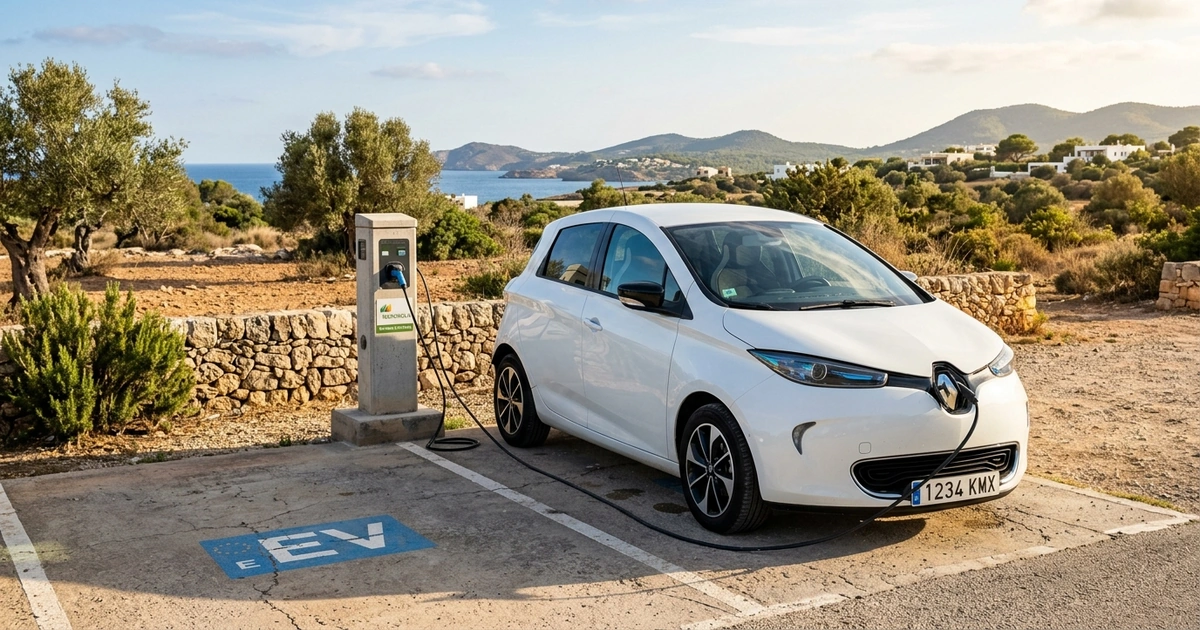

The car waiting in the parking lot of a Spanish airport is almost never electric. So far in 2026, only 1.5% of passenger cars registered for rental without a driver are fully electric, the lowest proportion of all the uses we've analyzed in this series: the overall market stands at 9.9%, and even taxis, which rely on cars as tools, register 15% electric vehicles. The rent-a-car sector accounts for one in six new cars in the country, yet it is the channel that electrifies its purchases the least.
Traditional rental has tried twice, and neither attempt has solidified: first with the Tesla and Polestar push in 2022 and 2023, dismantled in 2024; then with the small car wave of 2025, which the start of 2026 has not confirmed. That's why their electric registrations don't follow an adoption curve like taxis or leasing, but rather a sawtooth pattern: a 19% drop, a 156% rise, a 40% drop, a 109% rise, and in 2026, another 41% decline to the same date. These figures tell the story of this erratic journey, which also begins where no one would expect, in the shared cars of Madrid.
A clarification on what we've looked at. We analyzed the registrations of new passenger cars with "rental without driver" use, according to the DGT registry. Within this category, two different businesses coexist: the classic rent-a-car — the car rented by the day at an airport or a holiday office — and urban carsharing by the minute, which the DGT classifies under the same rental without driver. Excluded are vans, used cars, and leasing, which is a long-term contract and already has its own analysis in this series.
A sawtooth, not a curve
The channel multiplied its electric registrations by thirteen in a decade: 434 in 2015, 991 in 2019, 2,212 in 2021, 5,769 in 2025. However, the shape of this increase is not one of adoption. Taxis or leasing progress with small fluctuations; rental moves erratically, with two double-digit declines in four years and increases that double the previous year.
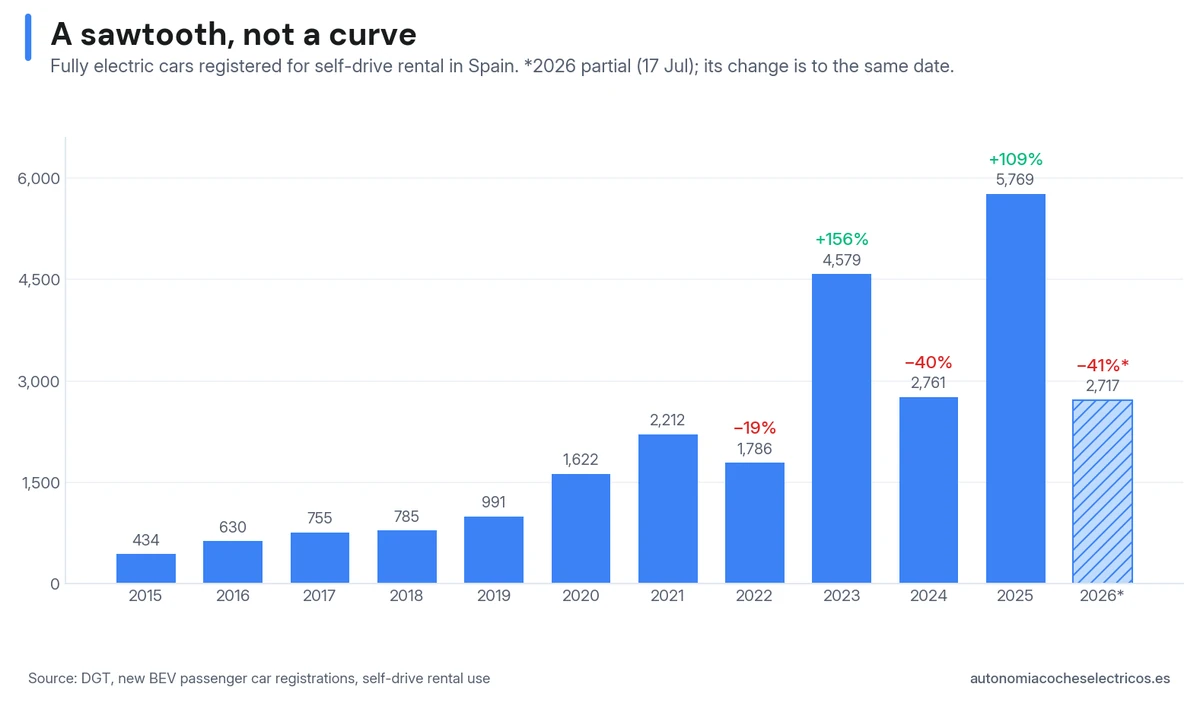
The explanation lies in how this channel buys. A rental company doesn't add a car when a customer requests it: it places orders for hundreds or thousands of units at once, timed for the high season. In a channel where electric vehicles are a minority, a single order — or its cancellation — shifts the data for the entire year.
Another clue that fleets are in charge here is in the weight. In 2015, rental without a driver accounted for 37.4% of all electric cars registered in Spain: more than one in three. In 2026, it accounts for 3.9%. That enormous share in the early years wasn't due to holiday rentals, but a business that was just starting in Madrid. To understand this anomaly, we need to go back to the origin of the electric channel.
The first life: shared cars (2015-2021)
The top positions in the registry of those years form a peculiar lineup for rental cars: 351 Smart ForTwo in 2015, 465 Citroën C-Zero in 2016, 518 Renault ZOE in 2017. Microcars and urban utility vehicles, not exactly the car a family would use to tour Mallorca.
The calendar gives them away. car2go launched in Madrid in November 2015 with 350 electric Smart ForTwo. emov followed in December 2016 with 500 Citroën C-Zero. Zity arrived in December 2017 with 500 Renault ZOE. The registry doesn't specify who registers each vehicle, but the match between the announced fleets and the figures for each year is almost exact, and for the DGT, carsharing is vehicle rental without a driver. Everything indicates that much of the initial growth of the channel was driven by Madrid's carsharing, not holiday rentals.
That explains the 2015 figure: shared cars were born electric in a country where almost no one else was buying electric vehicles, and that's why a small channel came to account for more than a third of that year's BEVs.
The phase stretches to 2021 with the expansions of those fleets — the Smart ForFour, more ZOE — and closes with signs of change: that year, the Dacia Spring (505 units) and the Fiat 500e appear in the registry, entry-level cars that already pointed to another type of rental.
The second life: the Tesla experiment and the reversal (2022-2024)
In October 2021, Hertz announced the purchase of 100,000 Teslas, the largest electric order ever placed by a rental company, and in 2022 added another for up to 65,000 Polestars. The major rental companies, which had kept their distance from electric vehicles, decided to try them on a large scale, with the trendy car and in the midst of stock market euphoria.
The Spanish registry clearly reflects this wave. The Tesla Model 3 bursts onto the scene in 2022 with 145 units, from negligible figures; the Polestar 2 jumps from 75 to 375 between 2022 and 2023; they are joined by the Ford Mustang Mach-E and the Volkswagen ID.4.
2023 ended with 4,579 electric rentals, a 156% increase over the previous year. The registry doesn't name buyers, but the timeline matches point by point with the experiment of the major rental companies.
The reversal was just as swift. In December 2023, Sixt stopped buying Teslas citing their depreciation. In January 2024, Hertz informed the U.S. stock market regulator of the sale of 20,000 electric vehicles — a third of its electric fleet — later expanded to 30,000, with about $440 million in accounting charges. Their reasons, in writing: the repair costs of electric vehicles and a resale value that fell more than expected. In Spain, 2024 ended with 40% fewer electric rental registrations: the Polestar 2 deflates, Tesla disappears from the top positions, and the year is led by the Mercedes-Benz EQA and the BYD Seal.
The sector's scare had a basis. In the UK market, where the data is better measured, a three-year-old used electric vehicle lost 57% of its value in the 21 months leading up to mid-2024, compared to 12% for an equivalent gasoline vehicle. For a business that buys cars knowing it will resell them in a matter of months, that difference determines the bottom line.
The third life: the small car wave (2025-2026)
In 2025, rental companies tried again, but with a different logic. No longer the image electric, but the small and affordable car: 1,021 Citroën e-C3, 821 Peugeot e-2008, 408 Fiat 500e, 317 Opel Mokka. Stellantis placed four of its brands at the top, and the year ended with 5,769 units, more than double that of 2024. This type of car fits better in the rental business: it costs less, amortizes faster, and if resale goes awry, the loss is measured in thousands of euros, not tens of thousands.
2026, for now, returns to caution. These are the most registered electric rentals up to 17 July:
The list maintains the utility profile — Stellantis still accounts for half — but without last year's wave: the e-C3 falls 78% compared to the same date in 2025, and the total for the channel is down 41%.
What powers rent-a-car: the technology breakdown
Pure electric occupies only a corner of the channel. The total of rental cars — all energies — reveals the background of the change, and the protagonist is the same as in taxis and leasing. The table shows the share of each technology over the total of new rental passenger cars registered each year.
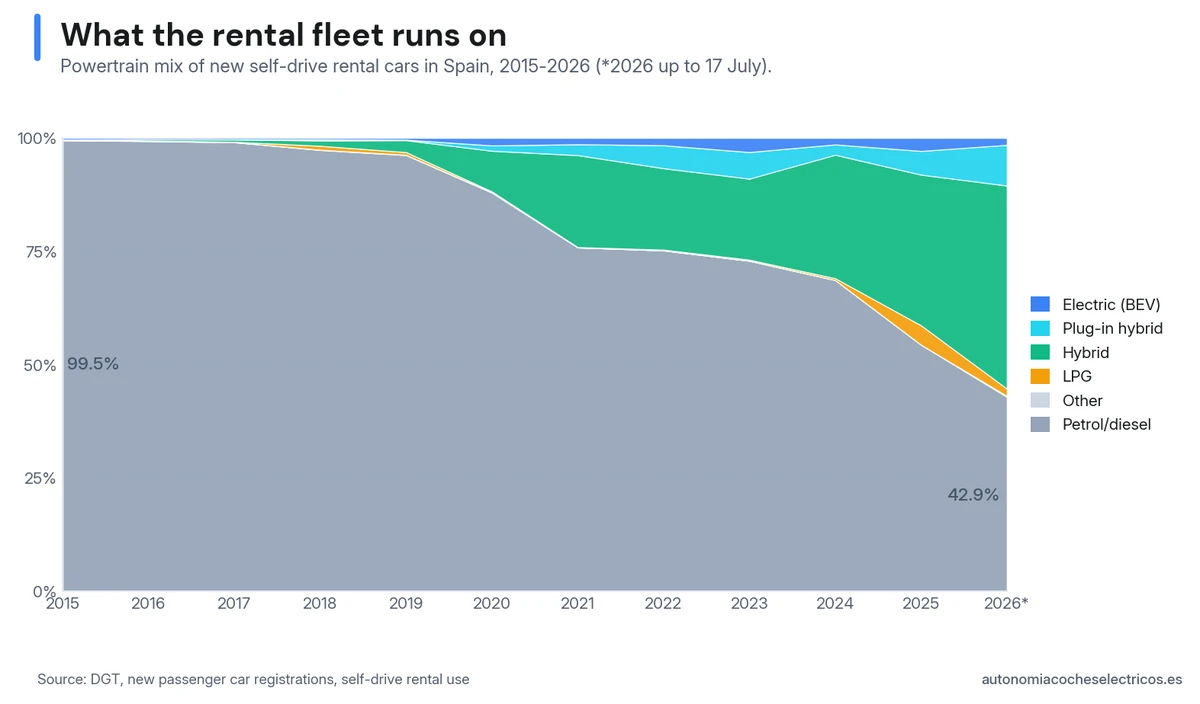
*2026, up to 17 July (partial data).
Two things stand out. First, how late everything arrived: in 2019, rent-a-car was still 96% gasoline and diesel, while taxis were already registering 44% hybrids. Rental buys the car with the lowest total cost during its time in the fleet — what it costs to operate and, above all, what it retains in value when resold — and for years that calculation pointed to combustion without question.
Second, the abruptness of the recent shift. Pure combustion has fallen from 96% to 43% in seven years, and who takes its place is the hybrid: 44.8% of the channel at the start of 2026, in line with leasing (51%) and on the path of taxis (64%). The logic repeats: the hybrid provides an ECO label and fuel savings without changing operations — no chargers in the parking lot, no explanations to the customer at the counter. The atypical note of 2025 is the LPG, with 8,537 units (4.3% of the channel), an unprecedented peak in the series.
Plug-ins — electric plus plug-in hybrids — account for 10.7% of the channel in 2026, half of the 21.7% that the overall market marks in the same period. In this too, rental lags behind.
Why the largest channel electrifies the least
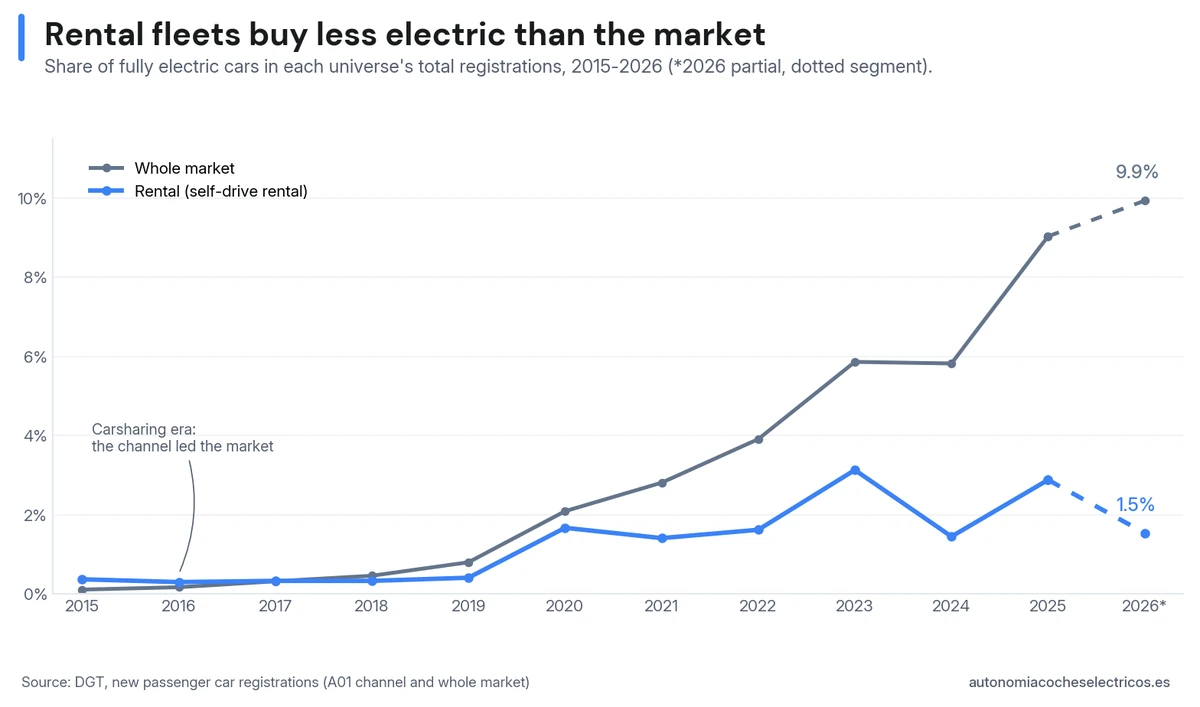
The contrast is striking due to the size of the channel: rental without a driver accounted for 17.4% of all passenger car registrations in 2025 — one in six new cars in the country — but only 5.5% of electrics. Out of every hundred cars it bought, less than three were battery-powered, compared to nine in the overall market. The reasons are twofold, and both point to the business model.
The express rotation. A rental company doesn't keep the car: it registers it before summer, uses it in high season, and resells it within months. The calendar confirms it: in 2025, 79% of electric rentals were registered between January and June, and in August and September there were hardly any new registrations — the sector itself describes it as stocking up for the summer campaign. With that rotation, resale value is the entire business. And electric is precisely the technology whose resale has raised the most doubts in recent years, as Hertz and Sixt learned the hard way.
The customer who didn't choose the car. Those who rent an electric car often didn't request it: they got it at the counter. For a driver who has never charged a car, solving a vacation with unknown chargers, new apps, and a range they don't master is a source of friction — and complaints. Hertz even mistakenly charged gasoline refills to customers returning a Tesla, and in its 2024 pullback admitted it needed new policies and educational tools to improve its customers' electric experience. Translated from corporate language: they were delivering cars that people didn't know how to use.
What the start of 2026 says
The current year repeats the pattern of caution. Up to 17 July, 2,717 electrics compared to 4,624 in the same period of 2025: a 41.2% decrease, while the Spanish electric market grows by 34.9%. The reading requires two nuances. The first is the calendar: we compare to the same date because comparing half a year against a full year would exaggerate the drop to −53%. The second is the waves: the 2025 figure included the massive e-C3 order, and without an equivalent operation, the year drops on its own.
Even with the nuances, the signal is clear. The channel as a whole is having a strong year — 176,573 registrations of all energies up to 17 July — and yet electric has once again been left out of the big orders. The third life of electric rent-a-car, for now, has lost momentum.
The first electric for many people
There's a reason to follow this channel that has nothing to do with its volume. For thousands of drivers, the first contact with an electric car doesn't happen at a dealership or in a friend's car: it happens in a rental car, sometimes without having requested it. That first experience matters. Those who manage their vacation week without hiccups return home thinking electric works; those who spend the first afternoon searching for a compatible charger take years to want to repeat.
Rental companies know this — the experience of their customers is among the declared reasons for the pullback — and that's why their caution speaks volumes. Rent-a-car thrives on eliminating friction: pick up the keys and drive away.
When delivering an electric is as easy as delivering a gasoline car, massive purchases will return on their own. We'll keep updating these figures as the years close, because the day rental electrifies without fear will also signal that charging an electric car is as natural for a tourist as refueling gasoline is today.