

When electric cars were barely selling in Spain, there was one channel where they were already circulating: leasing. A decade ago, when private buyers weren't even considering it, leasing accounted for nearly four out of every ten fully electric cars registered in the country. It was the incubator for electric vehicles in Spain, the channel that took a risk on a technology the rest of the market was still viewing from afar.
Ten years later, that picture has flipped. Leasing continues to register electric cars —many more, in fact— but it has fallen behind the market. Today, private buyers are adopting electric cars at a higher rate than leasing, and what has retired diesel in this channel isn't the plug, but the hybrid. These figures illustrate that role reversal.
A clarification on what we've examined. We analyzed the registrations of new passenger cars in leasing, according to the DGT registry. Leasing is a long-term rental: a monthly fee with insurance and maintenance included, and the car returned at the end of the contract. It's used by companies, freelancers, and increasingly, private individuals. It's this contract that defines these cars, not the use they are put to, and it has nothing to do with short-term rentals for vacations. Vans and used cars are excluded.
From 79 to 17,000: ten years of electric leasing
In terms of volume, the growth is hard to overstate. In 2015, 79 electric leasing cars were registered across Spain. By 2025, it was 17,174. The annual figure has multiplied by more than two hundred in a decade, and it has done so with almost no setbacks: 786 in 2016, 1,870 in 2018, 3,906 in 2020, 9,120 in 2023, up to the leap in 2025, when it nearly doubled compared to the previous year.
If we stopped here, the conclusion would be as expected: leasing is strongly pushing electric vehicles. But the absolute number is misleading, because the entire market has grown simultaneously, and not all have grown at the same pace. To know if leasing is ahead or behind, we need to look at it in proportion, not in isolated units.
The market share that falls while the number rises
Here's the twist. In 2016, leasing accounted for 38.7% of all electric cars registered in Spain: when barely any BEVs were sold, four out of ten were registered through leasing. That share has been declining ever since. In 2023, it was 16.6%, in 2025, 16.5%, and so far in 2026, it's down to 12.9%. Leasing hasn't lost momentum —it's registering more electric cars than ever— but the rest of the market has moved faster.
The clearest comparison comes from crossing two weights. In 2016, leasing represented 14% of all passenger car registrations in the country, but it accounted for 38.7% of electric cars: it weighed almost three times as much in electric cars as it did in the market. By 2025, the relationship has reversed. Leasing now accounts for 24.6% of all registrations, a huge channel, yet it only signs 16.5% of electric cars. Where it once led, it now lags.
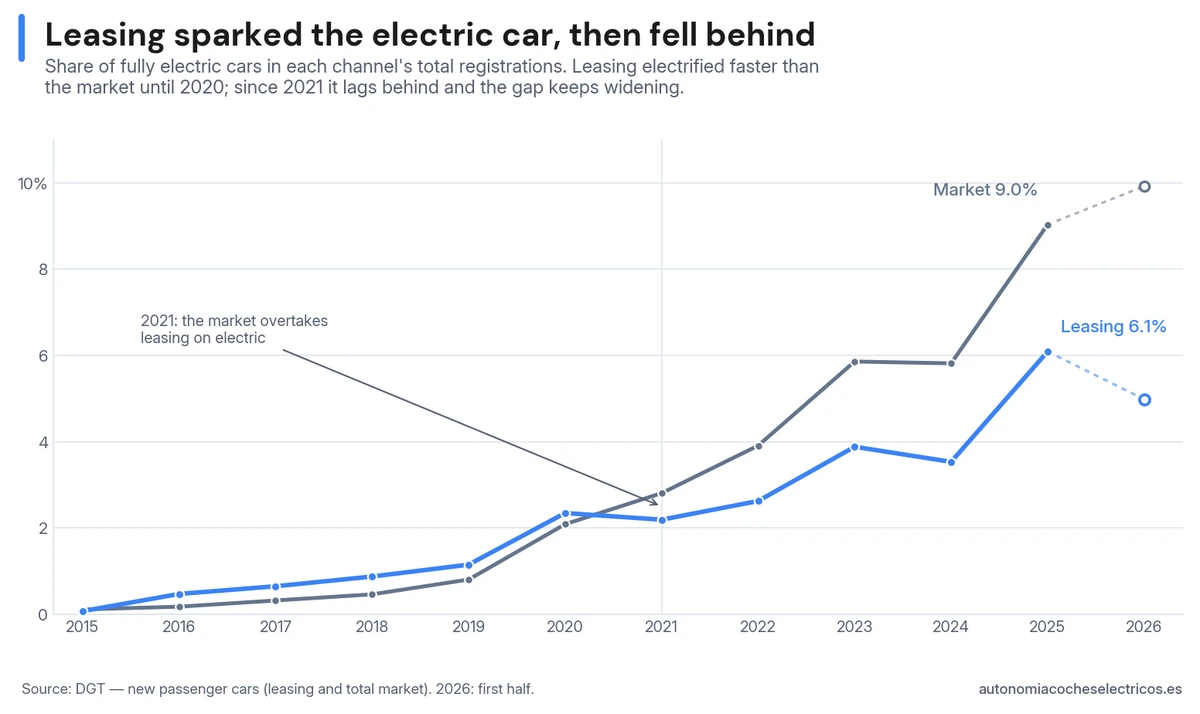
Looking internally, the contrast is even more direct. Out of every hundred leasing cars registered in 2025, six were pure electric. In the overall Spanish market, that figure was nine. The buyer going solo —private, freelancer, company buying directly— is adopting electric cars at a higher rate than leasing. The crossover occurred in 2021: until that year, leasing always electrified above average, and since then, it has fallen below, with the gap widening each year.
Three shifts: from urban microcar to affordable SUV
The electric leasing car is well understood through the models that dominated each stage, as each shift tells a different story about how leasing was used.
The microcar and shared car (2015-2019). Initially, the electric leasing car was small and urban: the Renault ZOE, the Citroën C-Zero, the Nissan Leaf, and especially the Smart ForTwo and ForFour, which led the ranking with over seven hundred units a year. Behind those figures were fleets of shared and urban delivery cars, not private drivers. Leasing was then almost the only channel daring to go electric, which is why it captured such a significant portion of the BEV market.
The premium company car (2020-2024). With the arrival of electric cars with more range, leasing changed its face. It filled with German premium sedans and SUVs: the Mercedes EQA, the BMW iX1 and i4, the Tesla Model 3 and Model Y, the Audi and the Volvo. It was the company car and the executive's in-kind compensation, a use where tax benefits help and the starting price matters less. In 2024, the most registered electric leasing model was the Tesla Model 3, with 696 units.
The affordable SUV and the Chinese brand (2025-2026). The current stage moves downmarket. The most registered electric leasing car of 2025 was the Jeep Avenger, with nearly 1,500 units, followed by the Citroën e-C3 and the Kia EV3: entry-level models, not premium. And for the first time, Chinese brands appear, with the BYD Seal making it among the most registered. These are the most registered electric leasing cars in the first half of 2026:
The list mixes what previously didn't come together: the affordable urban SUV from Jeep or Opel, the Korean compact, the Chinese sedan, and the usual German premium. Leasing in 2026 offers much more choice than in 2018, when almost everything registered was a Smart or a ZOE.
What powers leasing: the technology breakdown
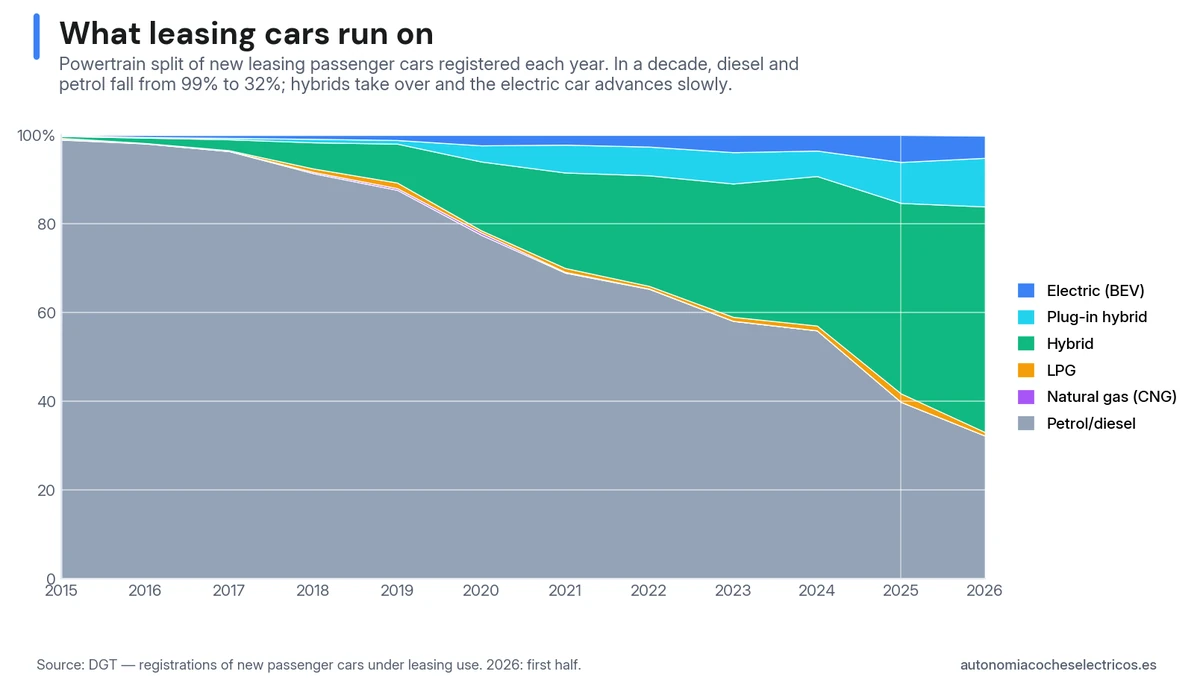
Pure electric doesn't compete alone, and when looking at the total leasing cars —of all energies— it's clear who has won the game. It hasn't been the plug. The following table shows the weight of each technology over the total of new leasing passenger cars registered each year.
*2026, first half (partial data).
The major driver of change in leasing has been the hybrid, just like in taxis. From representing almost nothing in 2015, the hybrid label has accounted for 42.9% of leasing cars in 2025 and already exceeds half at the start of 2026. Leasing abandoned diesel, yes, but mostly switched to hybrids: it keeps the traditional tank and refueling, gains the ECO label, and saves fuel without having to rely on a plug or charger.
Meanwhile, pure combustion has plummeted from 99% in 2015 to 32% in the first half of 2026. LPG never rose above anecdotal in leasing, unlike in taxis, and natural gas is negligible. Pure electric is growing, but slowly: it's the vanguard of leasing, not its backbone. If we add everything that plugs into the grid —electric and plug-in hybrids— leasing reaches 16% in the first half of 2026, still below the 21% that the overall market marks in the same period.
Why leasing slows down precisely with electric
That a channel as rational as leasing lags behind private buyers in electric cars has an explanation that points to the heart of its business: residual value. A leasing company doesn't sell mobility; it manages assets. It buys the car, rents it out for a few years, and recovers much of its investment by reselling it. Its bottom line depends on accurately predicting how much that car will be worth at the end of the contract.
And here, electric cars have caused some shocks. In the UK market, where the data is more measured, used electric cars lost 46% of their value between 2023 and 2024, compared to 19% for an equivalent petrol or diesel, a collapse that has cost the leasing sector hundreds of millions. We don't have such detailed Spanish data, but the mechanism is the same in any market: when the resale price of a technology is uncertain, those who live off that resale think twice. That's why everything points to leasing taking refuge in hybrids, whose residual value it knows well, leaving private buyers to absorb the uncertainty of electric cars.
Adding to this is the fiscal fit. Much of leasing is company and freelancer cars, with a deductible monthly fee and no immobilized assets on the balance sheet. This format explains why electric leasing cars were premium during the in-kind compensation stage and more affordable now that the product is opening up to private buyers. But favorable taxation hasn't been enough for leasing to outpace the market in electric cars: the brake of residual value has weighed more.
What the start of 2026 tells us
The data for the current year confirms the trend rather than breaking it. In the first half of 2026, leasing registered 8,463 electric cars, a 4.7% decrease compared to the same period in 2025. It's a small drop, but notable for the contrast: in those same six months, the overall Spanish electric market grew by 32%. While electric cars are booming among other buyers, in leasing, they are stagnating.
It's worth reading that −4.7% carefully because half a year isn't compared to a whole year. The DGT registry marks an apparent drop of almost 50% for 2026, but it's a calendar mirage: it compares six months against twelve. Compared to the same date in 2025, the decline is 4.7%, and that's the honest number. Leasing isn't collapsing, but it isn't keeping pace with the electric surge experienced by the rest of the market.
The thermometer that fell behind
For years, this channel was the best indicator of where electric cars were headed in Spain: those who moved cars in volume and watched costs jumped in before anyone else. That signal is still useful, but now it says something different than it used to. Leasing shows us that the shift from diesel to hybrid is practically complete, and that the leap to pure electric, on the other hand, is being made by private buyers before leasing itself.
It's not bad news for electric cars, but a nuance on how progress is being made. The technology no longer needs leasing to pave the way because private buyers have taken the lead. We will update these figures as the years close, because the day leasing electrifies faster than the market again will be a good sign that electric cars have no barriers left to break.
DGT Registrations
The key figures of electric cars in Spain, with the summary of the month and the current year.
02By Use
New electric cars in Spain by use: private, company, leasing, rental, and taxi, with the ranking of brands and models for each.
03Leasing
How many new electric cars are registered for rent-a-car in Spain, and which brands and models are chosen.
04VTC
How many new electric cars are registered for chauffeur-driven rental in Spain, and which brands and models are chosen.